


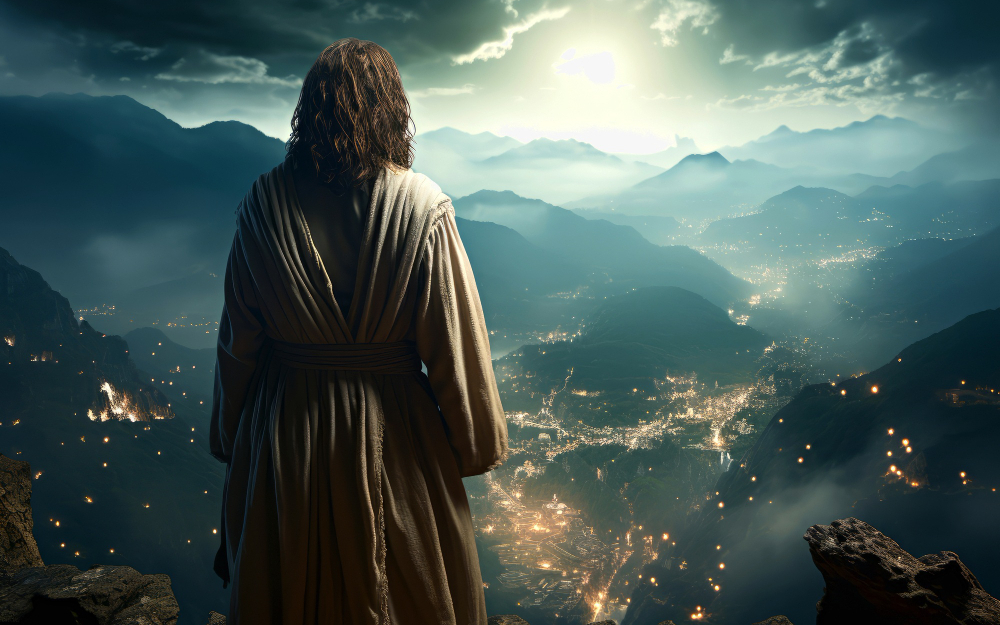
Christian Cosmogony arises from the biblical tradition of creation, but illuminates it through a central event: the incarnation of the Word.
For Christianity, the universe does not emerge merely through the word of God, but through the Logos itself, the eternal Word, who became flesh in Jesus Christ. Thus, creation is not only a remote event in the past, but the beginning of a story that involves fall, redemption, and the promise of renewal.
In this article, we will explore how early Christianity rereads Genesis in light of the person of Christ. We will see how creation is understood as the work of the Trinity, how the incarnation confers dignity and meaning upon matter, and how the idea of “New Creation” projects the destiny of the cosmos toward a final transformation. Origin and fulfillment meet in the same source: Christ.

The Christian context: reinterpretation and fulfillment
Christian Cosmogony does not arise in a vacuum, but as a radical reinterpretation of Jewish scriptures within the context of the Roman Empire and Greek philosophy.
Christianity as a reinterpretation of Judaism
The first Christians, being Jews, did not abandon Genesis. On the contrary, they read it through the lens of the life, death, and resurrection of Jesus of Nazareth.
They saw in Christ the hermeneutical key, that is, the central focus for understanding not only redemption, but also creation itself. The promises made to Abraham and the creation narrative were interpreted as finding their “yes” and “amen” in Christ (2 Corinthians 1:20).
The encounter with Greek philosophy
The preaching of Christianity in the Hellenistic world required dialogue with philosophical concepts.
The notion of the Logos, developed by philosophers such as Heraclitus and the Stoics as the rational principle that orders the cosmos, was appropriated and transformed by the Gospel of John to explain who Jesus was.
The question of creation and evil
The doctrine of creation ex nihilo was solidified in the early Christian period to combat dualistic views (such as Gnosticism and Manichaeism), which saw the material world as intrinsically evil, created by an inferior god.
For Christians, if God is good and is the sole Creator, then matter is fundamentally good, although corrupted by sin.

The creation narrative: the Logos and the Trinity
The foundational text of Christian Cosmogony is not found only in Genesis, but crucially in the prologue of the Gospel of John.
The preexistent Logos: the key to creation
“In the beginning was the Word, and the Word was with God, and the Word was God. He was in the beginning with God. All things were made through him, and without him nothing that was made was made.” (John 1:1–3)
This statement is a landmark in the history of Western thought. It identifies the creative agent of Genesis (“God said…”) as the Logos (Word), who is distinct from God the Father (“was with God”) and yet divine (“the Word was God”).
- Christ, the agent of creation: the historical Jesus is presented as the incarnation of the eternal Logos, through whom all things were created. This includes the physical cosmos, natural laws, time, and space. Colossians 1:16 echoes this: “For in him all things were created […] all things were created through him and for him.”
- Trinitarian cosmogony: although the doctrine of the Trinity was formulated later, its foundations are present here. Creation is understood as an act that involves the Father (the source of the creative will), the Son (the Logos, the agent and model of creation), and the Holy Spirit (who “hovered over the waters,” according to Genesis 1:2, being the force that gives life and completes creation). The universe is, therefore, the result of a relationship of eternal love within the Divinity.
The incarnation: God assumes creation
The culminating verse of the prologue of John is: "And the Word became flesh and dwelt among us" (John 1:14). The incarnation is the quintessential cosmogonic event of Christianity.
- The sanctification of matter: by assuming a complete human body, the creative Logos sanctifies matter in a definitive way. The Gnostic division between spirit (good) and matter (evil) is destroyed. The physical world is no longer merely "good" (Genesis), but becomes a potential vehicle for divine grace;
- Recapitulation (Anakephalaiosis): developed by theologians such as Saint Irenaeus of Lyon, this idea proposes that Christ "recapitulates" or "re-heads" the history of humanity. He is the New Adam (1 Corinthians 15:45). Where the first Adam disobeyed and corrupted creation, Christ, the New Adam, obeys perfectly, inaugurating a new beginning for humanity and for all creation.
The new creation: the destiny of the cosmos
The resurrection of Jesus from the dead is not seen merely as an individual miracle, but as the principle of the New Creation (1 Corinthians 15:20). It is the first fruit of a cosmic harvest that will transform all reality.
- The redemption of creation: the work of Christ is not only to save human souls, but to redeem all creation from the bondage of decay and sin. Romans 8:19-21 describes all creation "waiting with eager expectation for the revealing of the children of God," hoping to be "set free from the bondage of corruption";
- New heavens and new earth: the final destiny, described in the Book of Revelation, is not the annihilation of the physical world and an escape to a spiritual heaven, but the creation of "new heavens and a new earth" (Revelation 21:1). The original creation, redeemed and transformed, will be the eternal dwelling place of God with humanity. The cosmic narrative, therefore, begins with a garden (Eden) and culminates in a holy city (the New Jerusalem), symbolizing the fullness of redeemed community and culture.

Analysis and meaning: a Christified cosmos
Christian Cosmogony is a myth of the origin of the universe that introduces us to a dynamic, teleological, and deeply optimistic vision.
A cosmos with a redemptive purpose
The universe is not an autonomous mechanism or a stage for divine conflicts. From the beginning, it is "in Christ," created by Him and for Him. Its history is the story of its fall and its restoration through the same Logos who brought it into existence.
The dialogue with science (Cosmogenesis)
The doctrine of creation ex nihilo (from Nothing) and the belief in an ordering Logos historically provided fertile ground for the development of modern science.
Scientists such as Kepler, Galileo, and Newton believed they were "thinking God's thoughts after Him," unfolding the laws that the Logos had embedded in creation. The later conflict between "science and religion" arises more from specific literal readings of Genesis than from the central theological structure.
Human responsibility in creation
If creation is good and destined for redemption, the role of the human being as "steward" of creation (Genesis 1:28) gains tremendous urgency and ethical depth.
Ecology, for example, becomes a theological issue: caring for creation is participating in God's redemptive purpose for it.
Contrast with Judaism
While Jewish Cosmogony emphasizes the sovereignty and unity of the Creator and the observance of the Law (Torah) as a response, Christianity emphasizes the identity of the creative agent (Jesus) and His redemptive work as the force that restores the broken creation. The Law is fulfilled and transcended in the person of Christ.
Conclusion
Christian Cosmogony presents us with a universe that is, in its very essence, Christ-centered.
From the "Let us make man in our image, according to our likeness" of Genesis to the "And He who was seated on the throne said: Behold, I make all things new" of Revelation, the cosmic narrative is permeated by the presence of the eternal Logos.
Creation is not a clock built by a distant watchmaker, but a living drama of love, fall, and redemption, whose main actor is the Creator Himself, who enters His creation to rescue it from within.
The manger in Bethlehem and the cross at Golgotha thus become events of cosmic significance, revealing that the power that sustains the galaxies is, in its deepest nature, sacrificial love.
This vision of a God who becomes incarnate and redeems the matter He Himself created represents a unique development in the history of religions.
In contrast to this emphasis on incarnation and redemption, the Islamic tradition will formulate its own understanding of origins, reaffirming in an absolute way the unity, transcendence, and sovereignty of the Creator.
Islamic Cosmogony, with its theological power and radical simplicity, offers a perspective that also deserves to be considered on its own terms, just like other very distinct myths, such as Inca Cosmogony and Shinto Cosmogony.
Take the opportunity to read about them and see you next time!
May the Light of Love be the guide of all paths, at all times, in all circumstances, with all the people. And may Love foster Peace!
Bibliographical references
1. PELIKAN, Jaroslav. Christianity and Classical Culture: The Metamorphosis of Natural Theology in the Christian Encounter with Hellenism. Yale University Press, 1993.
Deeply examines the dialogue between early Christian theology and Greek philosophy, crucial for understanding the evolution of the concepts of Logos and creation.
2. MCGRATH, Alister E. A Fine-Tuned Universe: The Quest for God in Science and Theology. Westminster John Knox Press, 2009.
Explores the relationship between the theology of creation (especially the idea of the Logos) and discoveries in modern scientific cosmology, including the fine-tuning of the universe.
3. WRIGHT, N. T. The Day the Revolution Began: Reconsidering the Meaning of Jesus’s Crucifixion. HarperOne, 2016.
Although focused on the crucifixion, Wright’s book powerfully connects the work of Christ to the narrative of creation and new creation, placing it within the biblical cosmos.
4. TORRANCE, Thomas F. The Trinitarian Faith: The Evangelical Theology of the Ancient Catholic Church. T&T Clark, 1995.
Offers a profound exposition of how the early church councils developed a Trinitarian doctrine of creation, combating heterodox views.
5. BALTHASAR, Hans Urs von. Cosmic Liturgy: The Universe According to Maximus the Confessor. Ignatius Press, 2003.
Presents the thought of one of the greatest Christian theologians on creation, for whom the incarnate Logos is the key to deciphering the "logoi" (divine principles) of all created beings.