


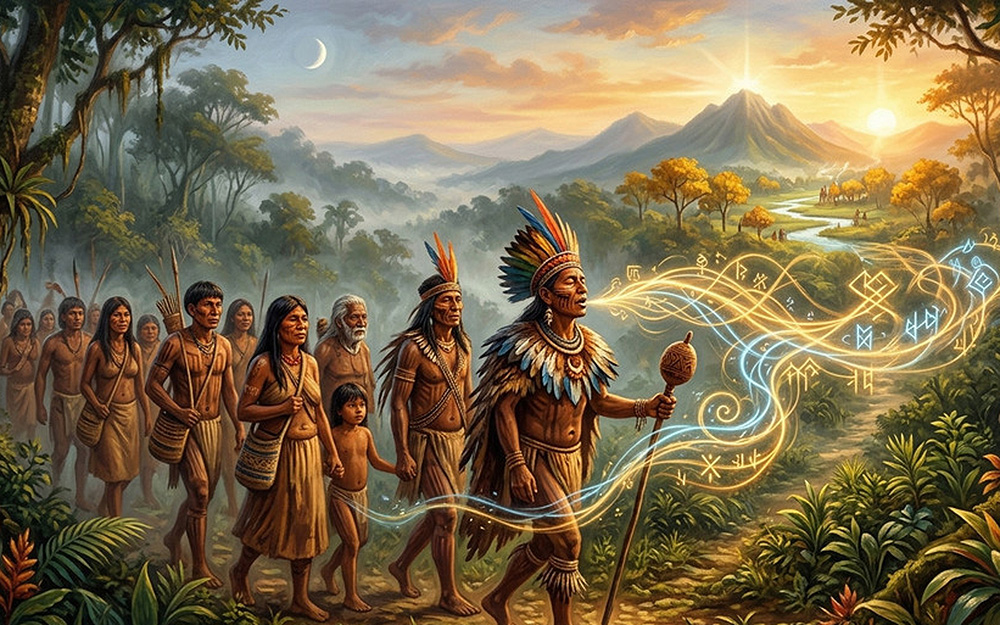
The myths of the origin of the universe are varied and very different from each other. In this article, we will take a journey through the Americas to dive into the heart of the Atlantic Forest and the vastness of the South American interior, where the Tupi-Guarani worldview — namely, Tupi-Guarani Cosmogony — flourished.
Here, creation is not a completed event in the past, nor a cycle of destruction and renewal, but a continuous process and a spiritual quest. The Tupi-Guarani cosmos is dynamic, sung into existence, and maintained by the ritual walking of its people toward the primordial paradise: the Land Without Evil (Yvy Marae'ỹ).
Unlike other cultures, such as Nordic Cosmogony and Yoruba Cosmogony, Tupi-Guarani Cosmogony is a belief system that places the word, the song, and sacred migration at the center of its relationship with the divine. Here we encounter a supreme and primordial god, Nhanderuvuçú (Our Eternal Great Father), who created the world through his breath and his light, and through the actions of cultural heroes such as the twins Kuaray and Jaci (Sun and Moon).
Prepare yourself for a narrative where history itself is a pilgrimage, where geography is an imperfect reflection of a higher world, and where humanity's ultimate goal is to rediscover the state of lost perfection.

The Tupi-Guarani context: mobility, shamanism, and the word-action
To understand Tupi-Guarani Cosmogony, it is essential to comprehend their social organization and their religious practice centered on the prophet-shaman.
A society of farmers and migrants
The Tupi-Guarani peoples were characterized by a semi-sedentary society, based on agriculture (cassava, corn) but also on hunting and gathering. They practiced significant mobility, driven not only by ecological factors but, above all, by a religious quest.
The shaman (Karai or Pajé) and the sacred word
The central figure is that of the shaman, the Karai (master of the word) or Pajé. He is the intermediary between the human and divine worlds. His power resides in the ritual word, song, and prayer (-embo'e). Through these practices, he influences reality, heals diseases, foretells the future, and guides his people. Creation itself is understood as an act of divine speech and song.
The ideal of the Land Without Evil (Yvy Marae'ỹ)
This is the central concept of Tupi-Guarani spirituality. The Land Without Evil is an earthly paradise, a place of immortality, abundance, and joy, free from suffering, evil, and death. It is not an afterlife heaven, but a physical place that can (and must) be reached through a long and perilous ritual migration. All history and cosmology are oriented by this quest.
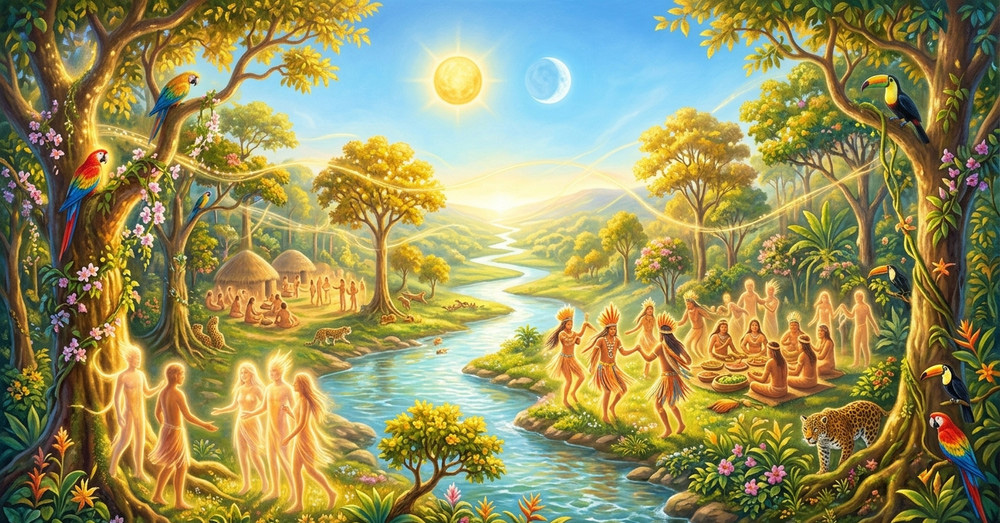
The creation narrative: the breath of Nhanderuvuçú and the order of the twins
Tupi-Guarani Cosmogony, transmitted orally, presents variations, but has a common and powerful core.
The primordial state and the supreme god
In the beginning, there was primordial darkness and chaos. There was no form, no life. In this void, Nhanderuvuçú (also called Ñane Ramõi Jusu Papa – Our Eternal Grandfather) already existed. He is the First and Only, the Originating Sun, the uncreated deity, omniscient and omnipresent, but also distant and impersonal. His essence is love and perfection.
Creation by word and light
Nhanderuvuçú created the universe from within himself, through his breath (-pytu), his creative word (-ñe'ẽ), and his own luminous substance. He created the Word-Soul (Ñe'ẽngue), a divine and vital principle that permeates all creation. Nhanderuvuçú's light expanded, separating the darkness and giving rise to the first foundations of the world.
Nhanderu and the creation of the imperfect world
In many versions, Nhanderuvuçú delegates the task of concrete creation to a secondary deity, Nhanderu (Our Father), also known as Maíra. Nhanderu is a demiurge — an active creator, but his work is imperfect.
He modeled the earth as we know it (Yvy), but it is a coarse and corrupt copy of the Land Without Evil. It was he who created the forests, rivers, animals, and also introduced suffering and death. For this reason, the current world is a place of trial and exile.
The twins Sun and Moon and the cultural order
A foundational narrative is that of the twins Kuaray (Sun) and Jaci (Moon). They are cultural heroes who gave shape and order to the world. In their adventures, they tamed primordial monsters, taught humans the arts of hunting, agriculture, rituals, and social organization. They established the fundamental duality that governs the cosmos (day/night, masculine/feminine) and became the rulers of cyclical time. Kuaray's victory over the monsters of darkness is reenacted at every dawn.
The creation of humanity
The first humans were created by Nhanderu from mud or clay, in a clear connection to the earth. However, just like the world, humanity is imperfect. Our bodies are heavy and subject to decay, in contrast to the spiritual lightness of the gods and the inhabitants of the Land Without Evil. Our soul, however, carries a divine spark, the vital breath (-pytu), which longs to return to its perfect origin.
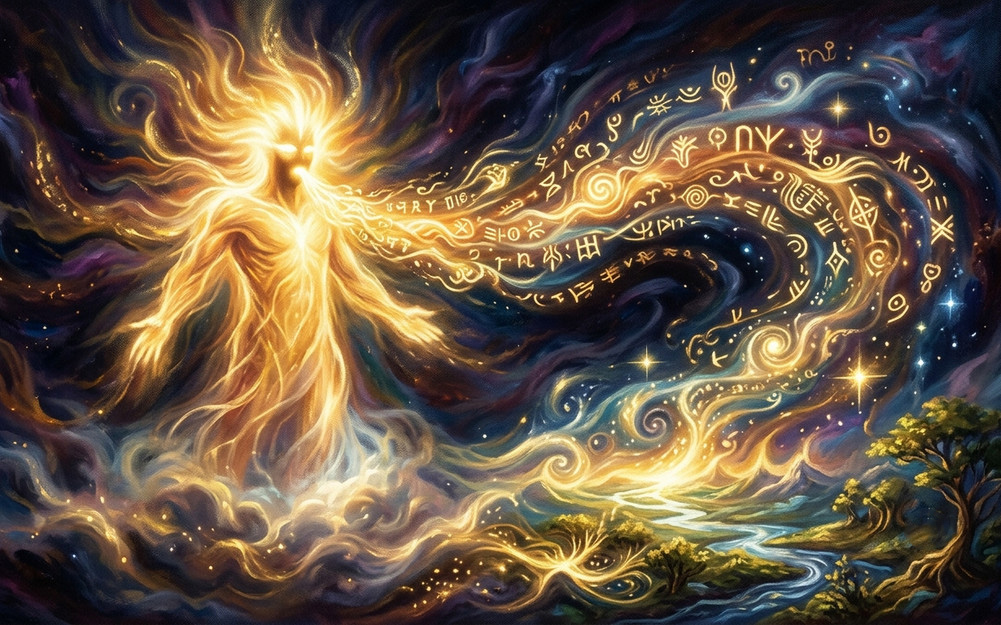
Analysis and meaning: cosmogony as a path to travel
It is very interesting to see how different cultures explain the origin of the universe. In the case of Tupi-Guarani Cosmogony, it reveals a worldview that is tragic, deep, and ethically demanding.
A two-layered cosmos
Reality is divided between the imperfect world (Yvy), where we live, and the Land Without Evil (Yvy Marae'ỹ), the perfect and original world. Creation is not finished; it is completed when humanity, guided by shamans, manages to cross the forest, the ocean, or ascend the heavens to reach this paradise.
Continuous creation through ritual
The existence of the world is not guaranteed. It must be sustained and "recreated" daily through the rituals, songs, and prayers of the Karai. With their powerful word, they combat the tendency toward chaos and decay in Nhanderu's world, keeping open the path to the Land Without Evil. Sacred migration is the greatest of these rituals.
The ethics of good living (Tekó Porã)
The quest for the Land Without Evil is not just geographical, but also ethical. This continuous search requires the community to live in harmony (-joayhu), following the principles of Tekó Porã (the good/ideal way of being). This includes generosity, reciprocity, respect for elders, and, crucially, a deep balance and respect with nature, which is seen as a living manifestation of Nhanderuvuçú's creative breath.
Contrast with Andean and Mesoamerican Cosmogonies
- Compared with Aztec and Mayan Cosmogony: There is no emphasis on complex calendars or the notion of cosmic cycles of destruction. The focus is linear: moving from an imperfect world toward a perfect one.
- Compared with Inca Cosmogony: It contrasts with state centralism and the figure of a divine emperor. Tupi-Guarani spirituality is more communal and guided by religious figures (shamans), rather than political one
Conclusion
Tupi-Guarani Cosmogony presents us with a universe born from the loving breath of a supreme god, but which took shape through the hands of a demiurge (a creator), resulting in the imperfect world we inhabit. It is a vision that transforms existence itself into a great pilgrimage, where the act of walking in search of the Land Without Evil is an act of recreating the world and oneself.
Creation, therefore, is not a starting point, but a destination. Humanity is, at the same time, exiled and pilgrim, carrying in the song and the rhythm of its march the hope of finding lost perfection once again.
This vision of a cosmos oriented by a spiritual quest shows us a profound facet of Amerindian thought. However, the cosmogonic tapestry of the Americas is even vaster and more diverse. How about deepening your knowledge of the cosmogonical patterns of North America?
I will see you soon!
May the Light of Love be the guide of all paths, at all times, in all circumstances, with all the people. And may Love foster Peace!
Bibliographical references
1. CADOGAN, León. Ayvu Rapyta: Textos Míticos de los Mbyá-Guaraní del Guairá. Universidad Nacional Autónoma de México, 1959.
A foundational work that compiles and translates the sacred hymns and myths of the Mbyá-Guarani, serving as the most important primary source on their cosmogony.
2. CLASTRES, Hélène. Terra Sem Mal: O Profetismo Tupi-Guarani. Editora Brasiliense, 1978.
A classic and essential analysis of the concept of Yvy Marae’ỹ and the prophetic-migratory movement as the central axis of Tupi-Guarani society.
3. MONTEIRO, John Manuel. Negros da Terra: Índios e Bandeirantes nas Origens de São Paulo. Companhia das Letras, 1994.
Provides the crucial historical context regarding the Tupi peoples, their social organization, and how their worldview influenced their interaction with colonizers.
4. SCHADEN, Egon. Aspectos Fundamentais da Cultura Guarani. Editora da Universidade de São Paulo, 1974.
A comprehensive anthropological study detailing the religion, social organization, and worldview of the Guarani, featuring a profound analysis of the concepts of soul, deity, and the role of the shaman.