


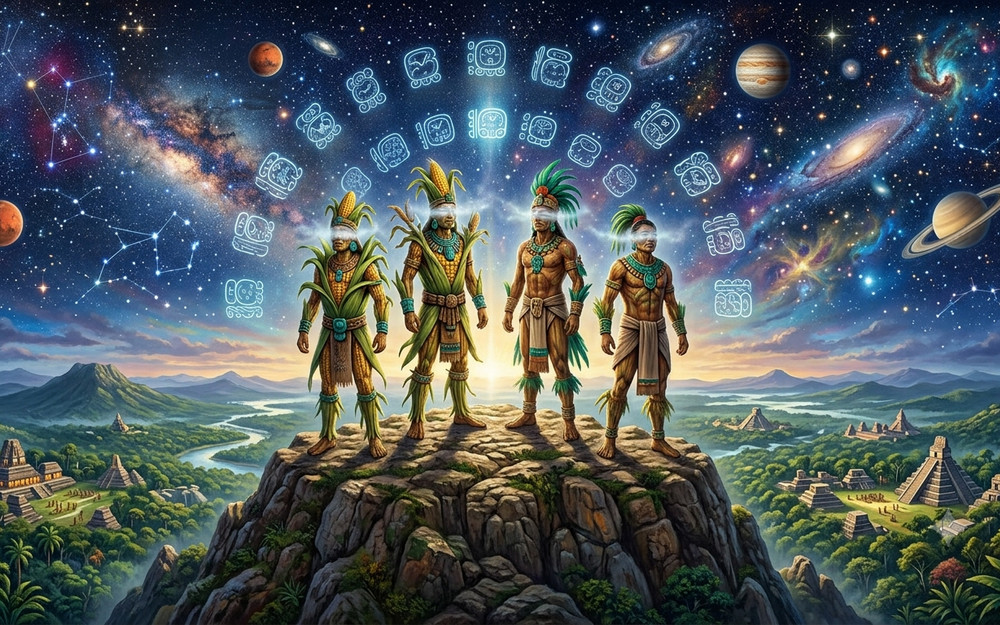
The human journey to decipher the origin of the cosmos unfolds into two major narratives: Cosmogony, which, through myths and symbols, explores the profound meaning of existence, and Cosmogenesis, which, through observation and reason, investigates the physical processes of the universe.
Today, we will explore Mayan Cosmogony, primarily through its literary and theological masterpiece, the Popol Vuh ("Book of the Community" or "Book of the Council"). We will follow the creator gods, Huracán ("Heart of the Sky") and others, in their sequential efforts to populate the world, from animals to wooden statues, culminating in the successful creation of humanity from corn.
We will see how this narrative is deeply intertwined with the heroic myth of the Hero Twins, Hunahpú and Xbalanqué, and their victory over the lords of the underworld, Xibalba.
Prepare yourself for a story where creation is a dialogue between the divine and the human, where knowledge – especially of astronomy and the calendar – is sacred, and where humanity finds its identity and purpose in a symbiotic relationship with the gods and with corn.

The Mayan context: cyclical time, calendars, and the Popol Vuh
To understand Mayan Cosmogony, it is essential to appreciate their unique relationship with time and the primary source of our knowledge.
The Popol Vuh as a foundational text
The Popol Vuh is the most important surviving Mayan mythological text, preserved by members of the nobility of the K'iche', a Mayan group during the colonial period. It narrates the creation of the world, the adventures of the twin gods, and the origin of the K'iche' people. This text is our primary window into the classical Mayan worldview.
The obsession with time and calendars
The Maya were exceptional astronomers and mathematicians. They developed a view of time as cyclical and loaded with religious meaning. Their complex calendars, such as the Tzolk'in (of 260 days) and the Haab' (of 365 days), were not just practical tools, but maps of divine influences. Creation was seen as an event unfolding within these sacred temporal structures.
A religion of nature deities
The Mayan pantheon was vast and complex, with gods frequently associated with natural phenomena (sun, rain, corn) and aspects of the calendar. Unlike the Aztec view, blood sacrifice, although practiced, was not the sole cosmic fuel; adoration, prayer, and maintaining cosmic order through the calendar were equally vital.
The creation narrative in the Popol Vuh: attempts, failures, and final success
Every culture attempts to explain the origin of the universe in its own way. Maori Cosmogony, for example, is a deeply genealogical and structuring narrative that goes from the Primordial Void to the arrival of the great migratory canoes in Aotearoa; while Sumerian Cosmogony presents the vision of a universe born from a cosmic ocean, structured by the separation of heaven and earth.
The creation in the Popol Vuh of Mayan Cosmogony is a deliberate process, but one marked by a search for the ideal form.
The primordial state and the first word
In the beginning, there was only a calm sea and an empty sky. The earth was submerged, enveloped in darkness. The creator gods, including Huracán (Heart of the Sky), were present in the waters, wrapped in green and blue feathers.
Creation begins with an act of intention and word: "Let there be void! Let there be fullness! Let the water recede and release the earth! Let clarity arrive at dawn in the sky and on the earth!"
The three attempts to create humanity
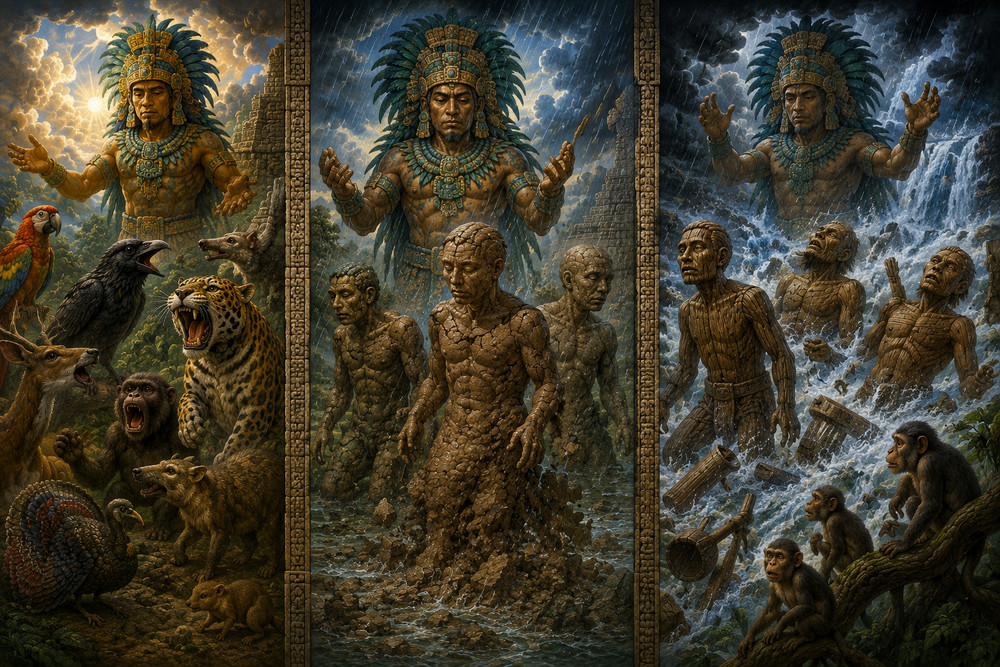
The gods desired beings who could worship them, sustain them, and invoke their names. Their creative journey had three main phases:
- The animals: The first attempt was the creation of animals. However, they were unable to speak and only screamed, chirped, and roared. Incapable of invoking the names of the gods, they were condemned to be eaten and sacrificed. This attempt failed.
- The mud man: In the second attempt, the gods molded beings from mud. They could speak, but they had no intelligence or memory. Their flesh was soft and disintegrated in the water. They could not move well and did not understand their creators. This attempt also failed.
- The wooden man: In the third attempt, the gods created beings carved from wood. They could speak, populate the earth, and use tools, but they had no heart, soul, or gratitude. They did not remember Huracán (Heart of the Sky) and did not worship him. As punishment, the gods sent a great flood and a rain of hot resin from the sky. Their own utensils and the animals turned against them. It is said that the survivors became monkeys, thus explaining their resemblance to humans.
The successful creation: the corn man
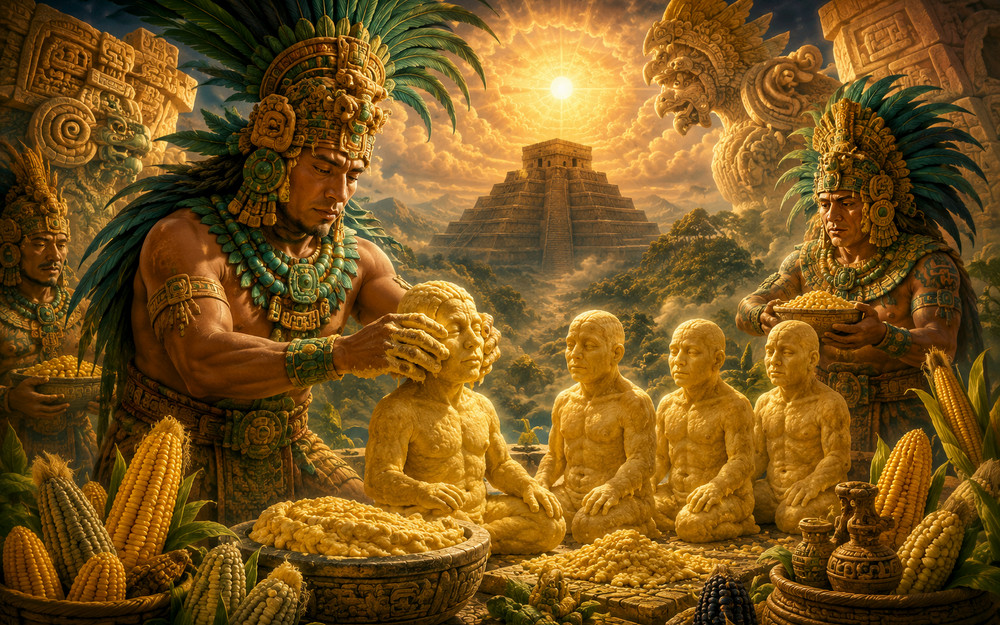
After the failure with wood, the gods decided to use a noble and sacred material: corn.
First, four animals – a coati, a coyote, a parrot, and a crow – find a mountain full of yellow and white corn, which became the raw material of life. The gods ground the yellow and white corn and, with the dough, molded four bodies. These became the first four men: B'alam Agab, B'alam Quitzé, Mahucutah, and Iqi B'alam.
This time, creation was a success. These men were wise, had clear vision, and could understand the vast universe. They could see and know everything, from the mountains to the valleys, and thanked the gods for their existence. However, their vision was so perfect that it threatened to make them equal to the gods themselves.
Worried, Huracán (Heart of the Sky) and the other creators blew a mist over the eyes of the first men, limiting their vision to what was near. In this way, perfect knowledge was replaced by wisdom and the ability to procreate, giving rise to the four main lineages of the K'iche' Maya people.
The creation of women
While the first men slept, the gods gave them wives. These women were created in an equally divine manner, and upon waking, the hearts of the men were filled with joy at the sight of them. Together, they populated the earth and initiated human lineages.
Analysis and meaning: dialogue, corn, and the cosmic order
Mayan Cosmogony reveals a worldview rich in symbolism and philosophical implications.
Creation as a dialogue
The relationship between gods and humans is dialogical. The gods seek creatures that can "speak their names," meaning establishing a relationship of worship and mutual recognition. Humanity is not an accident, but the result of a divine project seeking conscious companions in the cosmos.
Corn as the substance of life
Corn was not just a staple food; it was the very essence of human life. Mayan identity was literally founded on corn. This created a relationship of deep reverence and interdependence with the earth and the agricultural cycle, which was, in turn, a reflection of the cosmic order.
Knowledge and its limits
The myth explores the nature of knowledge. The perfect vision of the first corn men made them almost divine, but this was unsustainable. The true human condition, according to the myth, resides in an acquired wisdom, not in an innate and total knowledge. The pursuit of knowledge (especially of astronomy and the calendar) was, therefore, a spiritual effort to draw closer to the divine vision once again.
Heroism as part of creation
The narrative of the Hero Twins, Hunahpú and Xbalanqué, which precedes the creation of the corn man in the Popol Vuh, is fundamental. They defeat the arrogant lords of Xibalba (the underworld) and pave the way for the creation of humanity. This shows that the current cosmic order was achieved through heroism and intelligence, not merely granted.
Contrast with Aztec Cosmogony
While Aztec Cosmogony is centered on sacrifice as fuel to prevent destruction, Mayan Cosmogony is centered on the creation of a conscious and rewarding humanity for the gods. Sacrifice exists, but the focus is on dialogue and the symbiotic relationship between both parties.
Conclusion
Mayan Cosmogony, narrated in the epic Popol Vuh, presents us with a universe where creation is a deliberate, interactive, and ultimately successful process of collaboration between the divine and the human. It is a vision where humanity, made from the very sacred substance that sustains it (corn), finds its purpose in recognizing, worshiping, and dialoguing with its creators.
The limitation of our knowledge is not a curse, but a defining characteristic that impels us toward a continuous search for wisdom, mirrored in the meticulous effort of the gods to create us.
This vision of a cosmos structured by time, sustained by corn, and inhabited by a humanity conscious of its debt to the gods represents one of the most sophisticated systems of thought in the Americas.
If you enjoyed this adventure, it is also worth exploring the vast tropical forests of South America, where Tupi-Guarani Cosmogony offers us a profoundly different narrative, centered on the search for the Land Without Evil (Yvy Marae'ỹ) and the figure of the great civilizing hero Nhanderuvuçú.
Take the opportunity to also explore different views on the origin of the cosmos, such as Christian Cosmogony and Zoroastrian Cosmogony. See you soon!
May the Light of Love be the guide of all paths, at all times, in all circumstances, with all the people. And may Love foster Peace!
Bibliographical references
1. TEDLOCK, Dennis (Trad.). Popol Vuh: The Definitive Edition of The Mayan Book of The Dawn of Life and The Glories of Gods and Kings. Touchstone, 1996.
The most acclaimed and accessible academic translation and interpretation of the Popol Vuh, with profound commentary connecting the myth to Mayan culture.
2. COE, Michael D. The Maya. Thames & Hudson, 2011.
A classic and updated reference work on the Mayan civilization, providing the essential historical, political, and social context to understand their worldview.
3. FREIDEL, David; SCHELE, Linda; PARKER, Joy. Maya Cosmos: Three Thousand Years on the Shaman’s Path. William Morrow, 1993.
An innovative study that explores the continuity of Mayan cosmology over three millennia, connecting the myth of the Popol Vuh to art, architecture, and ritual practice.
4. CHRISTENSON, Allen J. Popol Vuh: The Sacred Book of the Maya. University of Oklahoma Press, 2007.
Another respected translation, with a detailed introduction that situates the text within the Mayan religious and literary tradition.