


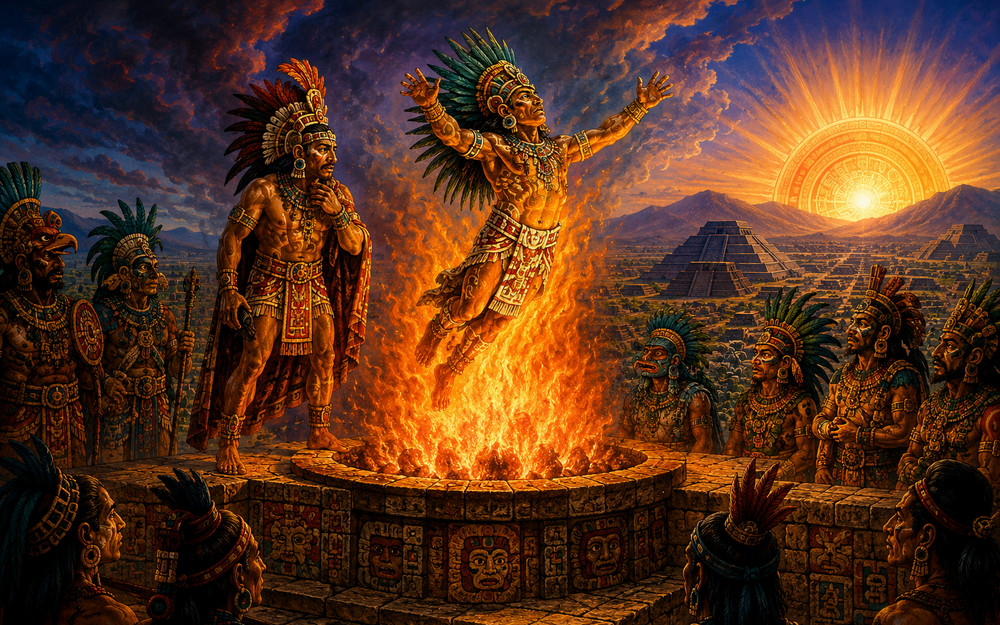
The human journey to decipher the origin of the cosmos takes different forms in every culture. Today is the day to explore Aztec Cosmogony.
After having already explored Celtic Cosmogony, Islamic Cosmogony, among others here on the blog, we turn our eyes to a worldview where creation is not a single or linear event, but a violent, cyclical, and tragic process.
For the Aztecs, the universe depends on the most extreme divine sacrifice to continue existing. In this article, we will explore the story of the Five Suns, the self-immolation of the gods in Teotihuacan, and understand how this narrative justified the practice of human sacrifice, in a world where daylight itself is a precarious achievement.

The Aztec context: cycles, sacrifice, and the flower war
To understand Aztec Cosmogony, it is crucial to dive into their view of time and their relationship with the divine:
- A cyclical and catastrophic view of time: just like other Mesoamerican cultures, such as Mayan Cosmogony, the Aztecs believed that time was cyclical. They lived in the expectation that the current era, like the previous ones, could end at any moment in a universal catastrophe. This was not an abstract belief, but a driving force behind their religious and political practice.
- Sacrifice as cosmic fuel: the central principle was that the sun, the rain, the earth, and the gods themselves required vital energy to keep themselves alive and in motion. This energy was tonalli (vital force), contained in human blood and hearts. The nextlahualli sacrifice ("the payment of the debt") was not an act of cruelty, but a cosmic necessity to postpone the collapse of the universe and the arrival of the end of the Fifth Sun.
- The flower war (Xochiyaoyotl): to obtain the sacrificial victims necessary to "feed" the gods, the Aztecs waged the "Flower Wars." These ritualized conflicts against neighboring city-states had the primary objective of capturing enemy warriors for sacrifice, in a cycle of death that sustained the life of the cosmos.
The creation narrative: the era of the five suns
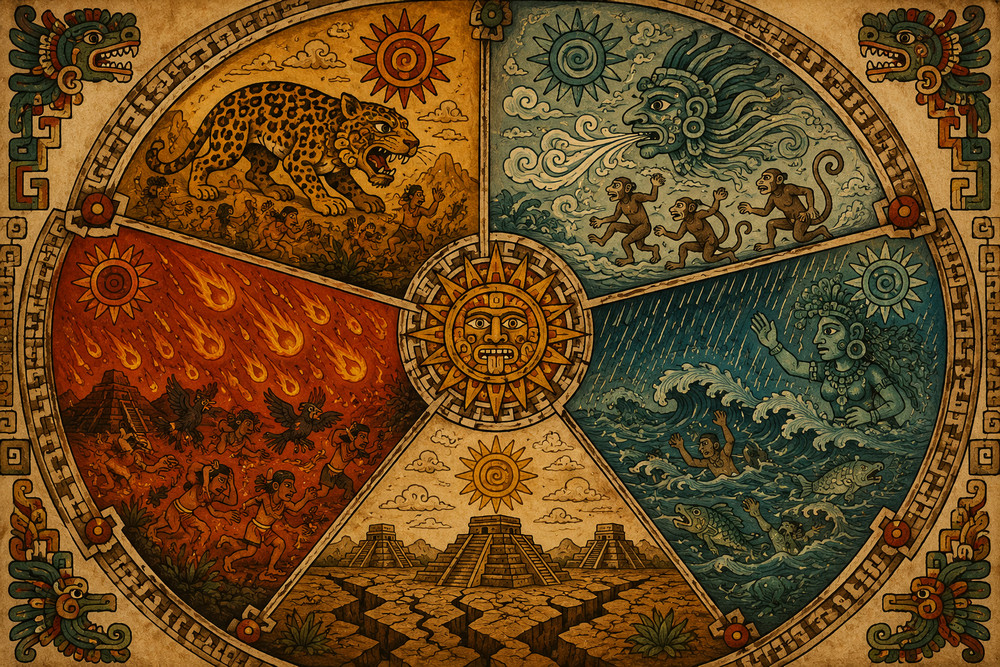
Aztec Cosmogony is told through the succession of five eras or "suns", each ruled by a god and destroyed by a specific catastrophe:
The primordial state: cosmic dualism
In the beginning, there was only Ometeotl, the supreme, dual deity and creator author, who resided in the thirteenth heaven, Omeyocan ("The Place of Duality"). From Ometeotl emanated the primordial masculine and feminine forces, and subsequently, the other deities.
In some versions, the world began with Tonacatecuhtli (Lord of Our Flesh) and Tonacacihuatl (Lady of Our Flesh), who generated the gods of creation.
The four failed suns
Before our world, there were four suns, each inhabited by a race of beings and each ending in a catastrophic destruction. The order varies according to the source, but a common sequence is:
- Nahui Ocelotl (Jaguar Sun): the first sun, ruled by Tezcatlipoca. Its race of giants was devoured by jaguars.
- Nahui Ehécatl (Wind Sun): the second sun, ruled by Quetzalcoatl. Its race was destroyed by furious winds and the beings were transformed into monkeys.
- Nahui Quiahuitl (Rain of Fire Sun): the third sun, ruled by Tlaloc, the rain god. It was destroyed by a rain of fire and lava, and its inhabitants transformed into birds.
- Nahui Atl (Water Sun): the fourth sun, ruled by the goddess Chalchiuhtlicue. It ended in a great flood that lasted 52 years, and the beings transformed into fish.
Each of these eras failed, either due to a cosmic imbalance or a conflict between the gods, leading to the need for a new beginning.
The creation of the fifth sun in Teotihuacan
After the destruction of the Fourth Sun, the gods gathered at the mythical site of Teotihuacan ("The Place Where Men Become Gods") to create a new era. The question was: who would become the new sun?
Two gods offered themselves: the arrogant and wealthy Tecuciztecatl and the humble and ulcer-covered Nanahuatzin. A large bonfire was lit. Tecuciztecatl, out of fear, hesitated to jump. Nanahuatzin, without hesitation, bravely threw himself into the flames. Ashamed, Tecuciztecatl followed him.
The gods waited to see from whom the new sun would emerge. In the east, the sky began to glow. First, Nanahuatzin appeared, transformed into the Fifth Sun, radiant and powerful. Shortly after, Tecuciztecatl appeared, also bright, but with a lesser glow. The gods, fearing that two suns of equal intensity would burn the world, threw a rabbit into Tecuciztecatl's face, darkening his shine. He became the Moon.
However, the sun and the moon remained still in the sky. To set them in motion, the gods understood that a greater sacrifice was necessary. Quetzalcoatl himself (the Feathered Serpent) decapitated all the other gods, offering their blood and their lives to give life and motion to the Fifth Sun.
From this primordial cosmic sacrifice, the current era was born, Nahui Ollin (Sun of Movement), destined to be destroyed by terrible earthquakes.
The creation of the humanity of the fifth sun
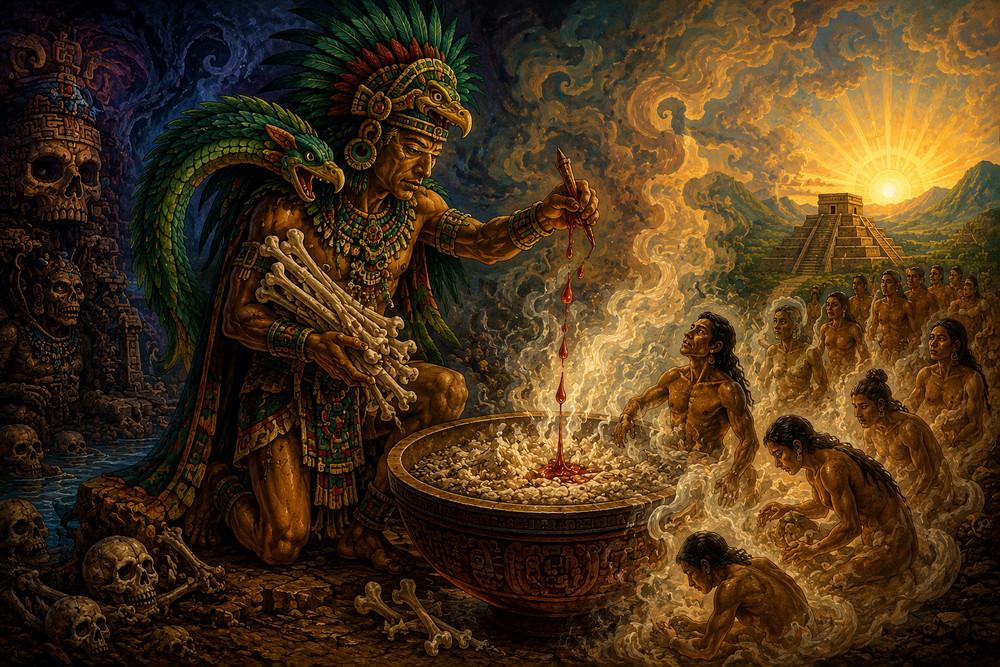
To populate this new world, Quetzalcoatl descended into Mictlan (the world of the dead) to retrieve the precious bones of the previous races. After tricking the god of death, Mictlantecuhtli, he recovered the bones, but tripped on his way back, breaking them. These broken bones were ground up and placed in a bowl.
Then, Quetzalcoatl and other gods pierced their genitals and let their blood fall onto the bone flour, thus creating the human race of the Fifth Sun. Once again, life emerged from divine sacrifice.
Analysis and meaning: a cosmos in perpetual debt
Aztec Cosmogony is one of the myths about the origin of the universe that reveals a tense, tragic, and deeply pragmatic worldview:
- Creation as an act of self-sacrifice: the creative act par excellence is not the word, procreation, or will, but self-immolation. The gods do not order the world from the outside; they become the world through their own suffering and death. This establishes a cosmic "debt" that humanity must help to pay.
- The precariousness of existence: the belief that the Fifth Sun could end at any moment in a catastrophe of earthquakes permeated Aztec life with a sense of urgency. The survival of the cosmos depended on correct human action – specifically, the offering of blood through sacrifice.
- The ideological justification of the Empire: cosmogony provided a powerful justification for military expansion and the practice of human sacrifice. The Flower War and the mass sacrifices at the Templo Mayor were not just acts of domination, but religious and cosmic duties to sustain the sun and prevent the end of the world. The Aztec state presented itself as the guardian of the universe.
- A universe in dynamic balance through blood: the Aztec cosmos was not static. It was a dynamic system that constantly lost energy (the sun moving, the gods aging) and needed to be replenished with the most potent vital force: blood (chalchihuath). Sacrifice was the cosmic ecology that maintained balance.
Conclusion
Aztec Cosmogony presents us with a universe born from the courage of a humble god and the collective sacrifice of the pantheon. It is a vision where creation and destruction are two sides of the same coin, where human life is literally made from the blood of the gods, and where the continuation of existence depends on a continuous and bloody payment.
It is a dramatic and demanding cosmos, which places a tremendous burden on humanity, transforming it into an active – and potentially flawed – partner in the struggle to keep the sun moving and ward off the ultimate darkness.
If you enjoyed this content, why not also check out our articles on Tupi-Guarani Cosmogony and Cosmogonic Patterns of North America? See you next time!
May the Light of Love be the guide of all paths, at all times, in all circumstances, with all the people. And may Love foster Peace!
Bibliographical references
1. LEÓN-PORTILLA, Miguel. Aztec Thought and Culture: A Study of the Ancient Nahuatl Mind. University of Oklahoma Press, 1963.
Seminal work that explores Aztec philosophy and worldview, including a deep analysis of the cosmogony of the Five Suns and its meaning.
2. MATOS MOCTEZUMA, Eduardo. The Great Temple of the Aztecs: Treasures of Tenochtitlan. Thames & Hudson, 1988.
Crucial link between myth and archaeology, showing how cosmogony was ritually enacted at the heart of the Aztec empire, the Templo Mayor of Tenochtitlan.
3. READ, Kay Almere. Time and Sacrifice in the Aztec Cosmos. Indiana University Press, 1998.
Focuses specifically on the interconnection between the concepts of cyclical time and the need for sacrifice in the Aztec worldview.
4. HISTORY OF THE KINGDOM OF NEW SPAIN (CÓDICE FLORENTINO). Bernardino de Sahagún. General History of the Things of New Spain. (Século XVI).
Indispensable primary source, compiled by the Franciscan friar Bernardino de Sahagún based on accounts from natives, containing detailed descriptions of the Aztec creation myths.