


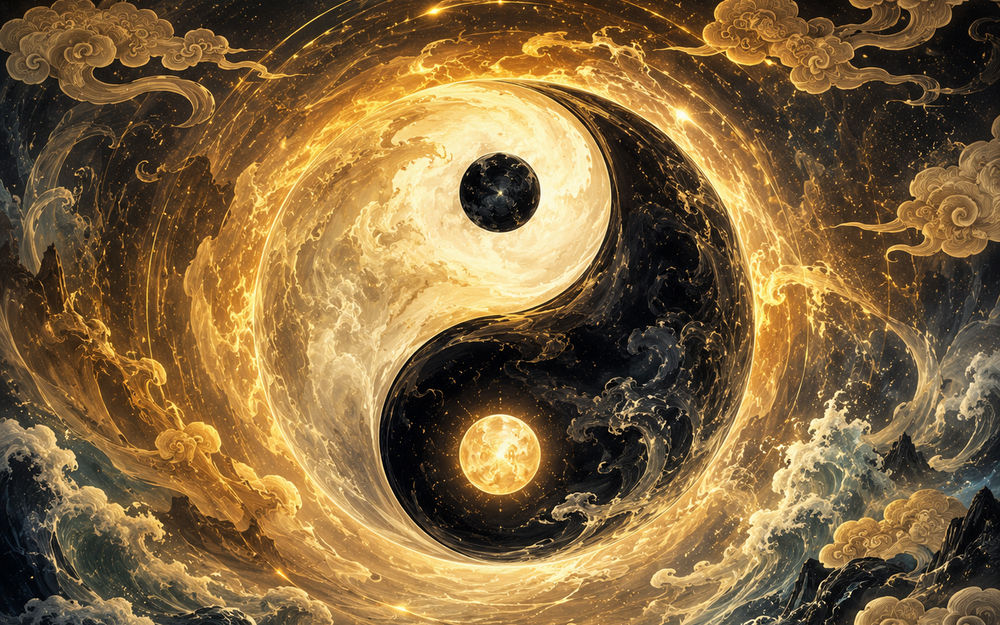
Chinese Cosmogony offers a unique answer to the question of the origin of the universe, based not on a personal creator, but on principles of balance, transformation, and harmony. In this view, the cosmos arises naturally from the Tao, the fundamental reality that sustains all things, and organizes itself through the dynamic interaction of complementary forces.
Rather than explaining an initial moment of creation, this tradition seeks to understand the patterns that keep the universe in constant motion.
Throughout this text, we will explore central concepts of Chinese thought, such as the Tao, Yin-Yang, and the Five Elements (Wuxing), as well as the famous myth of Pangu. Together, they reveal an understanding of reality in which order and change are not opposites, but natural expressions of the same cosmic harmony.

The Chinese context: philosophy, order, and the harmonious path
To understand Chinese Cosmogony, it is essential to appreciate its deeply philosophical character and its emphasis on natural and social order:
- A philosophical rather than myth-centered approach: unlike many traditions, classical Chinese thinkers did not focus on theogonies or anthropomorphic creator gods. Their concern was with the underlying principles of the universe's order, which they believed could be discovered through observation of nature and reflection.
- The importance of order (cosmos) over chaos: Chinese culture has always placed great value on order, hierarchy, and harmony, reflected in the concept of the "Mandate of Heaven" (Tianming) for rulers. The cosmogony reflects this by describing the transition from an undifferentiated state to one of ordered differentiation.
- The three schools of thought: the Chinese vision of creation was shaped by the interaction of three major currents:
- Taoism: focused on the impersonal Tao and the natural flow of the universe.
- Confucianism: concerned with the moral and social order that mirrors cosmic order.
- The theory of the Five Elements (Wuxing): providing a system of correspondences that explains transformations in nature.
The narratives of creation: from the primordial void to the separation of Yin and Yang
Chinese Cosmogony can be understood through two main paths: the abstract philosophical path and the narrative mythological path.
The philosophical path: the Tao and cosmic emanation
At the heart of Taoist thought lies the Tao (Dao). The Tao is the ultimate, indescribable, and nameless reality, the source of everything and the principle that sustains the universe. The famous opening of Laozi's Tao Te Ching declares: “The Tao that can be named is not the eternal Tao.”
The cosmogonic process is described as an emanation from this primordial unity:
- Wu Ji (the void without polarity): the state of absolute unity and undifferentiation before existence.
- Tai Ji (the Great Ultimate): from Wu Ji emerges Tai Ji, which contains within itself the potential for all existence and, crucially, the seed of the fundamental oppositions.
- The generation of Yin and Yang: from Tai Ji emerge the two fundamental principles of the universe: Yin and Yang. Yin is the dark, feminine, receptive, passive principle, associated with the earth, the moon, and cold. Yang is the bright, masculine, active, creative principle, associated with the heavens, the sun, and heat. It is crucial to note that they are not opposing forces in conflict, but complementary and interdependent; each contains the seed of the other. The dynamic interaction between Yin and Yang generates and moves all things.
- The Five Elements (Wuxing): from the interaction of Yin and Yang emerge the Five Elements or Phases: Wood, Fire, Earth, Metal, and Water. These are not static elements, but phases within a cycle of continuous transformation. They generate and regulate one another in a specific sequence, forming the basis of all matter and phenomena in the universe.
The mythological path: Pangu and the separation of Heaven and Earth
Overlaying this philosophical vision is the popular myth of Pangu, which provides a vivid and anthropomorphic narrative of creation.
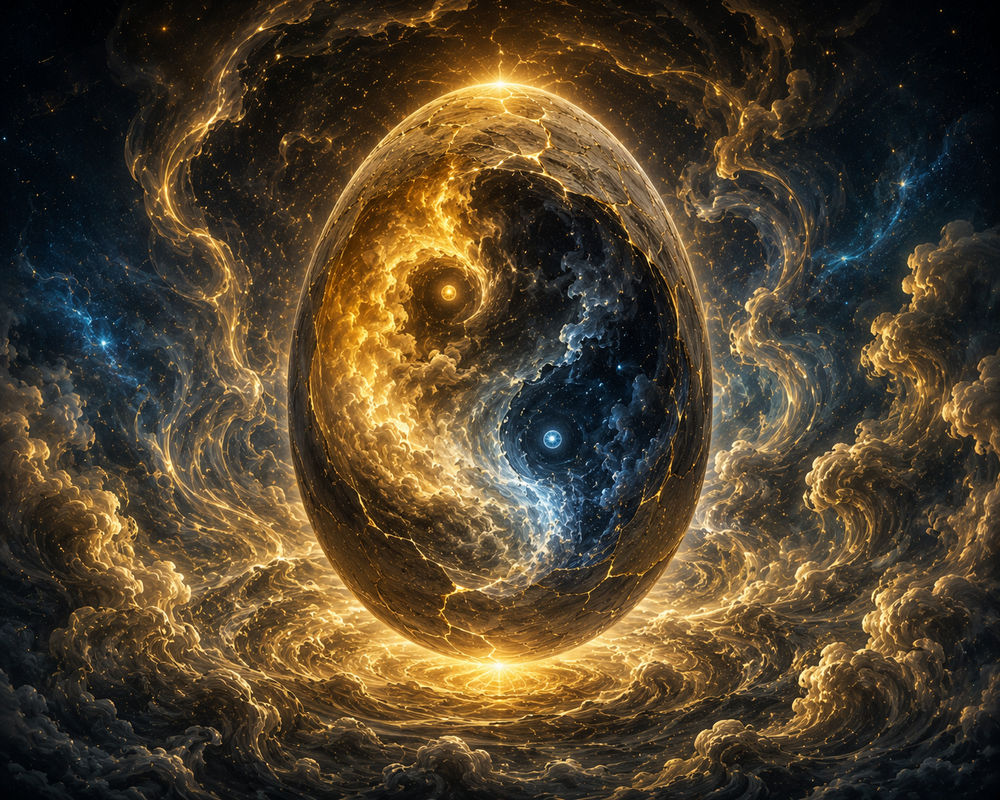
- The cosmic egg: in the beginning, the universe was a formless chaos resembling a cosmic egg. Within this egg, the opposing principles of Yin and Yang were mixed together.
- The birth of Pangu: within this egg, the primordial being Pangu was gestating. After 18,000 years, Pangu awakened and broke free, shattering the egg.
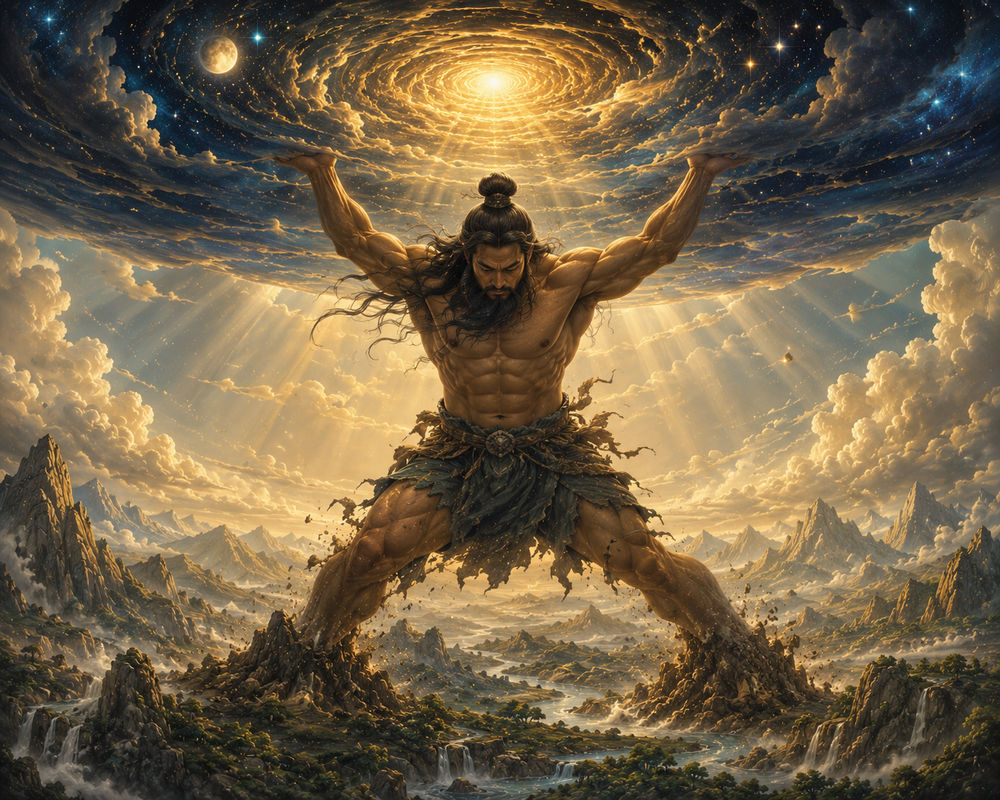
- The separation of Heaven and Earth: the light and pure parts of the egg (Yang) rose to form Heaven, while the heavy and murky parts (Yin) sank to form Earth. Fearing they would merge again, Pangu positioned himself between them, pushing Heaven upward and Earth downward. Each day he grew three meters taller, and Heaven and Earth separated by another three meters. This colossal task lasted 18,000 years.
- Pangu’s sacrifice and the creation of the world: when Heaven and Earth were finally stable and firmly established, the exhausted Pangu died. His body then transformed into all parts of the world:
- His breath became the wind and clouds.
- His voice became thunder.
- His eyes became the sun and the moon.
- His limbs became the mountains.
- His blood became the rivers and oceans.
- His muscles became the fertile lands.
- His hair became the stars and forests.
- His marrow became precious minerals.
- The fleas on his body became human beings.
Analysis and meaning: harmony, self-movement, and an implicit order
Chinese Cosmogony reveals an organic, dynamic, and deeply interconnected worldview.
- Creation as self-movement (Ziran): the concept of Ziran, often translated as “spontaneity” or “self-so,” is central. The universe was not created by an external entity; it emerges and transforms according to its own internal nature. The Tao is the principle of this self-movement, not a god who initiates it.
- The pursuit of harmony (Hexie): the cosmic, social, and personal goal is not conquest or domination, but harmony. Health, good governance, and inner peace are achieved when one is aligned with the Tao and when Yin and Yang are in dynamic balance within the body, society, and cosmos.
- Complementarity rather than conflict: the Yin-Yang relationship serves as a model for all relationships. Oppositions such as light/dark, masculine/feminine, and heaven/earth are viewed as necessary and mutually defining. This perspective avoids the radically antagonistic dualisms found in other traditions.
Contrast with other traditions
Versus Abrahamic Traditions, such as Islamic Cosmogony: it replaces a personal creator god with an impersonal principle (the Tao) and a natural process of differentiation.
Versus Hinduism: although both traditions contain ideas of emanation, the Chinese model is non-theistic and much more focused on complementarity than on dramatic cycles of creation and destruction.
Versus Buddhism: it shares a certain impersonal character, but while Buddhist Cosmogony focuses on the cessation of suffering, Chinese thought emphasizes harmonious integration with the cosmic flow.
Conclusion
Chinese Cosmogony presents a living and self-organizing universe that emerges naturally from a principle of unity and develops through the constant interaction of complementary forces. It is a vision that values balance, transformation, and the interdependence of all things, showing that order does not need to be imposed but can arise spontaneously from the very dynamics of reality.
By placing the Tao at the center of existence, this tradition offers an understanding of creation based less on extraordinary events and more on the patterns that sustain life, nature, and the cosmos.
If you wish to deepen your study of how different cultures explain the origin of the universe, Shinto Cosmogony also offers a fascinating perspective, deeply connected to the forces of nature and the sacred character of the natural world.
May the Light of Love be the guide of all paths, at all times, in all circumstances, with all the people. And may Love foster Peace!
Bibliographical references
1. LAOZI. Tao Te Ching. Trad. de Stephen Mitchell. HarperCollins, 1988.
The foundational work of Taoism, whose poetic verses describe the nature of the Tao and the process of the universe’s emanation. Mitchell’s translation is both accessible and poetic.
2. FENG, Yu-Lan. A History of Chinese Philosophy, Volume I: The Period of the Philosophers. Princeton University Press, 1952.
A classic reference work that traces the development of Chinese philosophical thought, including the cosmogonic ideas of Taoism and Confucianism within their historical context.
3. GIRARDOT, N. J. Myth and Meaning in Early Taoism: The Theme of Chaos (Hundun). University of California Press, 1983.
A seminal study exploring the concept of Chaos (Hundun) in Chinese mythology and philosophy, connecting it to cosmogonic narratives.
4. BIRRELL, Anne. Chinese Mythology: An Introduction. Johns Hopkins University Press, 1993.
Provides translations and analyses of Chinese myths, including the complete narrative of Pangu, situating it within the broader context of Chinese mythological tradition.