


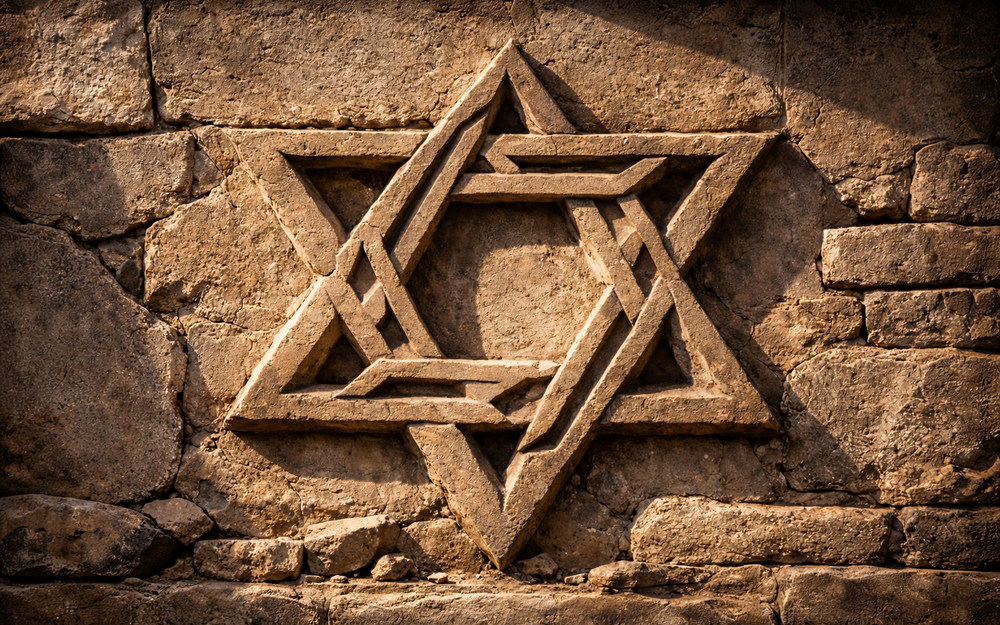
Jewish Cosmogony marks a decisive turning point among the myths about the origin of the universe. Unlike ancient narratives that describe battles between gods or primordial forces in conflict, here creation emerges as a sovereign, conscious, and ordered act of a single and transcendent God.
There is no cosmic dispute nor divine birth: there is the Word. Reality comes into existence through the power of the creative Word.
In this article, we will explore the narrative of the Book of Genesis, the first book of the Hebrew Bible (Tanakh). We will see how this worldview introduces transformative ideas, such as creation out of nothing, the essential goodness of the material world, and the human being as the bearer of the divine image — foundations that deeply shaped Western spiritual tradition.

The context of Genesis: monotheism and a new cosmic order
To understand the radical nature of Jewish Cosmogony, it is essential to place it within its historical and theological environment.
The Mesopotamian scenario and the monotheistic revolution
The people of Israel emerged in a world dominated by Mesopotamian cosmogonies, such as the Enuma Elish. In these, the cosmos was a divine battlefield, matter was preexistent, and humans were slaves of the gods.
The vision of Genesis is a clear counterpoint to this model. The God of Israel (YHWH) does not fight cosmic monsters. He overcomes them through the authority of His Word.
Chaos (tohu wa-bohu, “formless and void”) is not an antagonistic deity, but a passive state over which the Spirit of God hovers, ready to bring order.
Genesis as a theological, not scientific, text
It is crucial to read Genesis on its own terms. It is not a treatise on physics or biology, but a theological proclamation about the nature of God, the world, and humanity. Its central concern is the “why” and the “who,” not the “how” in measurable detail.
The structure of the two accounts
Genesis actually presents two complementary creation narratives:
- Genesis 1:1 – 2:4a: the “priestly” account, majestic and structured, with creation in six days;
- Genesis 2:4b – 2:25: an older and more anthropocentric account, focused on the creation of man and woman in the Garden of Eden.
The creation narrative: order, word, and the Sabbath
The first chapter of Genesis is a masterpiece of narrative theology, where creation unfolds as an ordered and intentional process.
The primordial state and the first act
The text begins solemnly: “In the beginning, God created the heavens and the earth.” (Genesis 1:1)
The earth was “formless and empty” (tohu wa-bohu), and darkness covered the deep. The Spirit of God hovered over the waters. Unlike the Egyptian Nun or the Babylonian Tiamat, these waters are not divine; they are part of inert and shapeless creation.
Then, the creative act itself begins, guided by the divine Word:
- Day 1: “Let there be light”: God speaks, and light appears. He then separates light from darkness, naming them “Day” and “Night.” The act of naming is an act of sovereignty, of dominion over what was created.
The structuring of the cosmos: separation and filling
The following days follow a pattern of separation and then filling:
- Day 2: God creates the “firmament” (raqia), separating the “waters above” from the “waters below.” The firmament He calls “Heaven”;
- Day 3: God gathers the waters below the heavens into one place, allowing dry land, “Earth,” to appear. Immediately, He fills it by commanding the earth to produce vegetation;
- Day 4: God fills the domain separated on Day 1 (Light/Darkness) with the luminaries: the Sun, the Moon, and the stars, to govern day and night and mark times;
- Day 5: God fills the domain separated on Day 2 (Waters and Sky) with aquatic creatures and birds, blessing them to be fruitful and multiply;
- Day 6: God fills the domain separated on Day 3 (Land) with land animals. Then, He performs the pinnacle of creation.
The pinnacle of creation: the image and likeness of God
God declares: “Let us make man in our image, according to our likeness.” (Genesis 1:26)
This is a statement without parallel in the ancient world.
- The image of God (Imago Dei): the human being (Hebrew adam, “humanity”) is not an accidental servant, but a creature that uniquely reflects the Creator Himself. This grants an inalienable dignity to every person. Traditionally, this “image” is understood as referring to the capacity for relationship, morality, creativity, and responsible dominion;
- The mandate of creation: humanity is entrusted with governing all creation, not as exploitation, but as stewardship and care;
- The creation of woman (Genesis 2): in the second account, the creation of woman (ishah) from the rib of man (ish) is deeply significant. She is not created from an inferior element, but from his own essence, highlighting equality of value and complementarity in the most fundamental relationship: “the two shall become one flesh.”
The consummation: the seventh day
On the seventh day, God completed His work and rested. This “rest” is not due to fatigue, but a creative cessation, a declaration that the work was complete, perfect, and very good.
The Sabbath (Shabbat) thus becomes an integral part of the very structure of creation — an eternal invitation for humanity to participate in the rest and fullness of God.
Analysis and meaning: the pillars of a new worldview
The Cosmogony of Genesis introduced conceptual pillars that would shape Western thought:
- Creation Ex Nihilo (out of nothing): although the doctrine was refined later, Genesis establishes its foundation: God is the unique and unconditioned cause of everything that exists. Matter is not eternal; it is a good creation, but not divine. This desacralizes nature, allowing scientific investigation, since it is no longer inhabited by capricious gods;
- The goodness of creation: after each creative act, God sees that it “was good.” In the end, He sees that it was “very good.” This is radical: the material world, the human body, sexuality — everything is intrinsically good. This opposes dualistic views that saw the physical world as a prison or a malignant illusion;
- The fall and the breaking of harmony: Genesis chapter 3, the narrative of the “Fall,” is fundamental to the Jewish (and later Christian) worldview. Human disobedience introduces sin, suffering, and death into the world, breaking the original harmony between God, humanity, and creation. Much of the subsequent biblical story is the narrative of restoring this broken relationship.
Contrast with neighboring cosmogonies
- Babylonian Cosmogony: instead of Marduk versus Tiamat (order through violence), we have God versus Nothing (order through the Word);
- Egyptian Cosmogony: instead of Atum self-created from the waters, we have a transcendent God creating and ordering the waters;
- Greek Cosmogony: instead of a Cosmos born from Chaos through conflict, we have Chaos (disorder) being transformed into Cosmos (order) through an act of loving will.

Conclusion
Jewish Cosmogony, centered on Genesis, represented a revolution in thinking about origins.
By presenting a single, transcendent, and good God, who creates a good world through His sovereign Word and grants unique dignity to humanity, it laid the foundations not only for a religion, but for a new way of relating to reality.
A criação não é um palco de guerras divinas, mas um dom sistematizado, um cosmos ordenado cuja história está intrinsecamente ligada às escolhas da humanidade, portadora de Sua imagem.
This understanding of an absolute beginning and of a humanity invested with spiritual responsibility would profoundly influence later traditions. Among them stands out the Christian worldview, which reinterprets the act of creation in light of the figure of Jesus of Nazareth.
How about expanding this reflection? Take the opportunity to also explore Christian Cosmogony and its theological implications.
May the Light of Love be the guide of all paths, at all times, in all circumstances, with all the people. And may Love foster Peace!
Bibliographical references
1. ALTER, Robert. The Five Books of Moses: A Translation with Commentary. W. W. Norton & Company, 2004.
An acclaimed translation that captures the rhythms and nuances of Biblical Hebrew, with deep literary and theological commentary on Genesis.
2. KASS, Leon R. The Beginning of Wisdom: Reading Genesis. University of Chicago Press, 2006.
A philosophical and scholarly reading of Genesis, exploring its profound reflections on the human condition, ethics, and the meaning of life.
3. WALTON, John H. The Lost World of Genesis One: Ancient Cosmology and the Origins Debate. IVP Academic, 2009.
Offers a crucial perspective, arguing that Genesis 1 describes the function and cosmic order of a “cosmic temple,” not the material origin of the universe, placing it firmly in its Ancient Near Eastern context.
4. SACKS, Jonathan. Genesis: The Book of Beginnings (Covenant & Conversation). Maggid Books, 2009.
Series of accessible and profound essays by the Chief Rabbi of England, offering insights from the rabbinic tradition on the creation narratives.