


The human search for the origins of the universe unfolds into two great narratives: Cosmogony, which, through myths and symbols, seeks the deep meaning of existence, and Cosmogenesis, which, through observation and reason, investigates the physical processes of the universe.
In Norse Cosmogony, creation is not an act of ordered divine immanence or a struggle for political power, but a brutal process of freezing and fusion, of primordial sacrifice, and of a fragile order carved from the body of a giant.
If in Greece (Greek Cosmogony) chaos was a void, in the Norse vision it is an active and icy emptiness — a stage for elemental forces in collision.
Norse Cosmogony presents a worldview deeply shaped by the harsh environment, the warrior ethos, and a tragic and heroic sense of fate. Today, we will discover how the universe was born from the meeting of fire and ice in the Primordial Void, how the gods built the world from the corpse of the first being, and how the very notion of time and destiny (the Norns) is woven into the structure of the cosmos itself.

The world of the Vikings: context and ethos of Norse creation
To understand Norse Cosmogony, it is essential to immerse oneself in the world that shaped it:
- A harsh and heroic environment: life in Scandinavia was a constant struggle against a severe climate, long winters, and scarce resources. This forged a culture that valued courage, resilience, loyalty, and posthumous fame above all. Death in battle was not a tragedy, but a glorious passage to Odin’s Hall, Valhalla;
- Heroic fatalism and Ragnarök: unlike cyclical or progressive views, the Norse worldview is linear and tragic. The universe has a beginning and will have a definitive end: Ragnarök, the “Twilight of the Gods.” In this final battle, gods and heroes will fight and die against the forces of chaos, and the world will be consumed by fire and water. Creation contains within itself the seed of its own destruction. To know this fate and still fight bravely is the essence of Norse heroism;
- The sources – the Prose Edda and the Poetic Edda: our understanding of Norse mythology comes mainly from 13th-century Icelandic texts compiled by Snorri Sturluson. It is crucial to remember that these were written centuries after the Christianization of Scandinavia and may contain Christian influences, yet they remain the most complete portrait we have of this rich tradition.
The narrative of creation: ice, fire, and the sacrifice of Ymir
Norse creation is a violent and organic process, which can be divided into distinct stages.
The primordial state: the void and the antagonistic worlds
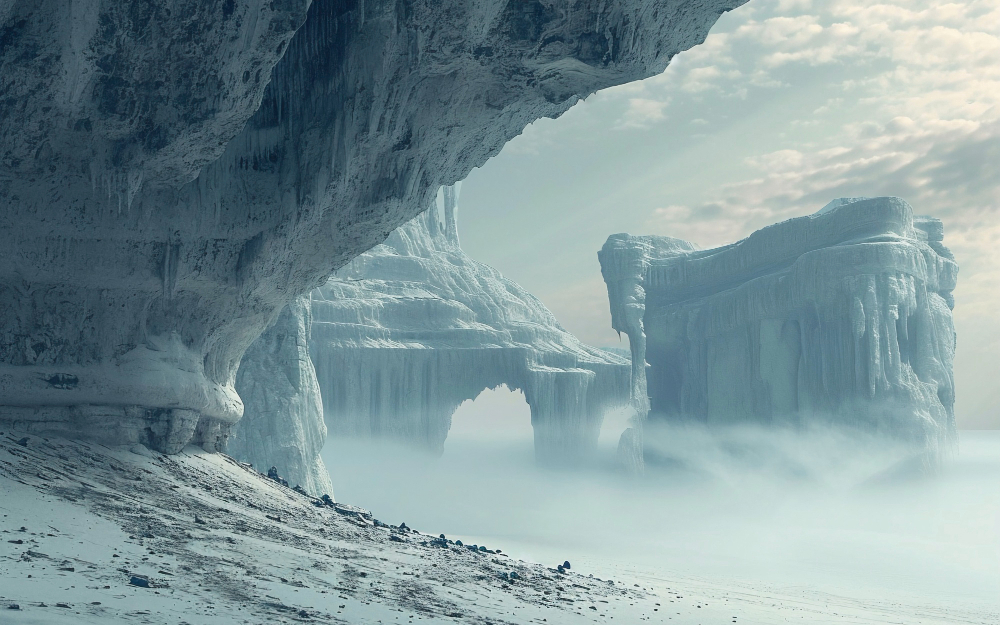
In the beginning, there was no sand, sea, or solid land. There was no sky above. There existed only Ginnungagap, a “yawning void,” a vast and primordial abyss.
To the north of Ginnungagap lay Niflheim (“World of Mist”), a realm of ice, snow, and eternal cold. At its center flowed the spring Hvergelmir, from which eleven icy rivers, known as Élivágar, emanated.
To the south existed Muspelheim (“World of Fire”), a region of incandescent heat, flames, and blazing fire, guarded by the fire giant Surtr, who wielded a flaming sword.
The thaw and the birth of life
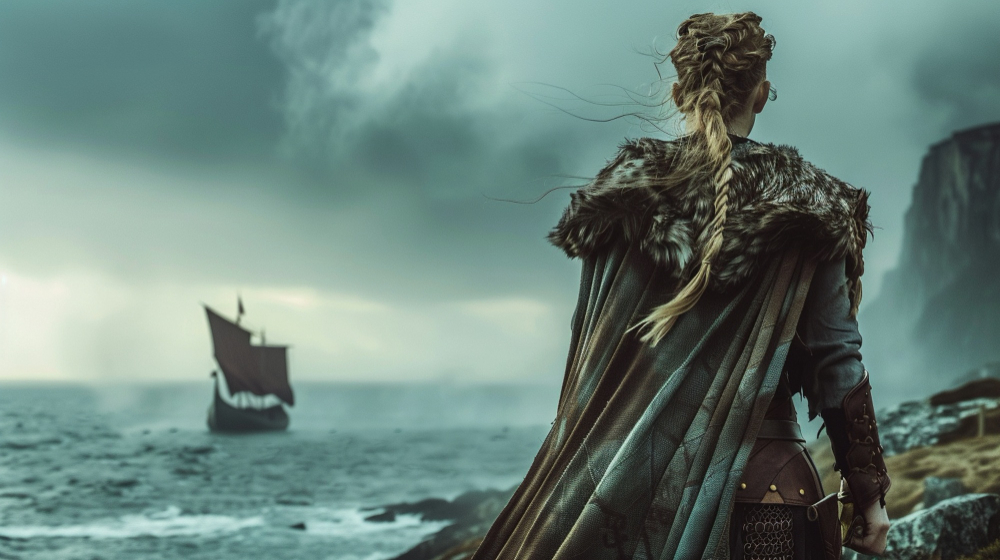
The heat of Muspelheim met the ice of Niflheim in the great void of Ginnungagap. The ice began to melt, and from the dripping and vapor, life emerged. From the flowing drops, the primordial giant Ymir was formed, the first being of the race of the Jotun (giants). While Ymir slept, he sweated, and from his filth (under his arms and between his feet) more giants were born.
At the same time, from the melting ice that revealed salt also emerged Audumbla, a giant cow. Her milk nourished Ymir. Audumbla, in turn, fed herself by licking the salty blocks of ice.
After three days of licking the ice, a being of human form emerged from the block: Buri, the first of the Aesir gods. Buri had a son, Bor, who united with a giantess, Bestla, giving rise to the first Aesir gods: Odin and his brothers, Vili and Vé.
The cosmic sacrifice and the creation of the world
The gods and the giants coexisted, but hostility grew. Odin and his brothers, driven by the desire to create, decided to kill Ymir. The flood of blood that gushed from his wounds was so immense that it drowned almost all the frost giants, except for a couple, Bergelmir and his wife, who escaped and continued the race of giants, now as eternal enemies of the gods.
Then, the three divine brothers dragged Ymir’s inert body to the center of Ginnungagap and began to build the world from his remains:
- From his flesh, they made the Earth;
- From his blood and sweat, they formed the Sea and all lakes and rivers;
- From his bones, they raised the Mountains and cliffs;
- From his teeth and broken bone fragments, they made stones and pebbles;
- His skull was lifted to form the vault of the sky, supported by four dwarfs, one at each cardinal point (Norðri, Suðri, Austri, and Vestri);
- With sparks and embers from Muspelheim, the gods dotted the sky, creating the Sun, the Moon, and the stars, and established their courses.
This newly created world, Midgard (“Middle Yard”), was then protected by a fence made from Ymir’s eyebrows, becoming the realm of humans, situated at the center of the cosmos, yet always threatened by the giants who lived beyond its borders, in Jotunheim.
The creation of humanity: Ask and Embla
One day, Odin, Vili, and Vé were walking along the shore and found two tree trunks brought by the tides. The gods decided to give them life and form:
- Odin gave them spirit and life;
- Vili gave them reason and movement;
- Vé gave them senses, speech, and expression.
Thus were born Ask (Ash) and Embla (Elm or Vine), the first man and the first woman, to whom the gods gave Midgard as their home. Humanity, therefore, is a direct divine creation, made from natural elements (wood) and endowed with the highest gifts of consciousness.
Analysis and meaning: fragile order, fate, and the heroic ethos
Norse Cosmogony reveals a worldview deeply consistent with the environment and values of its people.
- An order built from chaos (and crime): as in Babylon, order (Cosmos) is literally carved from the body of chaos (Ymir). However, this is not celebrated as an absolute triumph. It is a necessary act, but one that establishes a primordial guilt and an eternal conflict with the giants, representatives of the chaotic and untamed forces of nature. Order in Midgard is fragile and must be defended every day;
- The importance of sacrifice: Ymir’s sacrifice is the archetype of all sacrifices. It establishes that creation and the maintenance of life demand a high price. This theme echoes in Norse religious practice, which included sacrifices (blót), and in the figure of Odin, who sacrifices himself, hanging on Yggdrasil for nine days, to gain the knowledge of the runes;
- The World Tree: Yggdrasil and the interconnection of all realms: the Norse cosmos is not a flat disk, but a cosmic tree, the World Ash Yggdrasil. Its roots and branches connect the nine worlds (such as Asgard, Midgard, Jotunheim, Helheim). Yggdrasil is the axis of the world, a symbol of interconnection, but it is also under constant threat, being gnawed by creatures such as the dragon Nidhogg. Once again, order is dynamic and under stress;
- The Norns and the weaving of fate: at the base of Yggdrasil reside the Norns, three women (Urdr – What was, Verdandi – What is becoming, Skuld – What should be) who weave the fate (Wyrd) of gods and men. This introduces an element of fatalism into creation: the universe is not governed solely by the will of the gods, but by an implacable destiny that even Odin cannot alter, only delay.
Contrast with Abrahamic views and the legacy of Ragnarök
While Abrahamic Cosmogonies promise a final judgment that crowns a linear story of redemption, Ragnarök is a cyclical and tragic destiny. There is no transcendent god guaranteeing an eternal happy ending; there is only courage in the face of the inevitable and the fragile promise of a new cycle born from the ashes.
This acceptance of fate (wyrd) and the valuing of courage and loyalty, even in defeat, become the highest virtues in a universe without divine guarantees.
Echoes in the East: Slavic myths
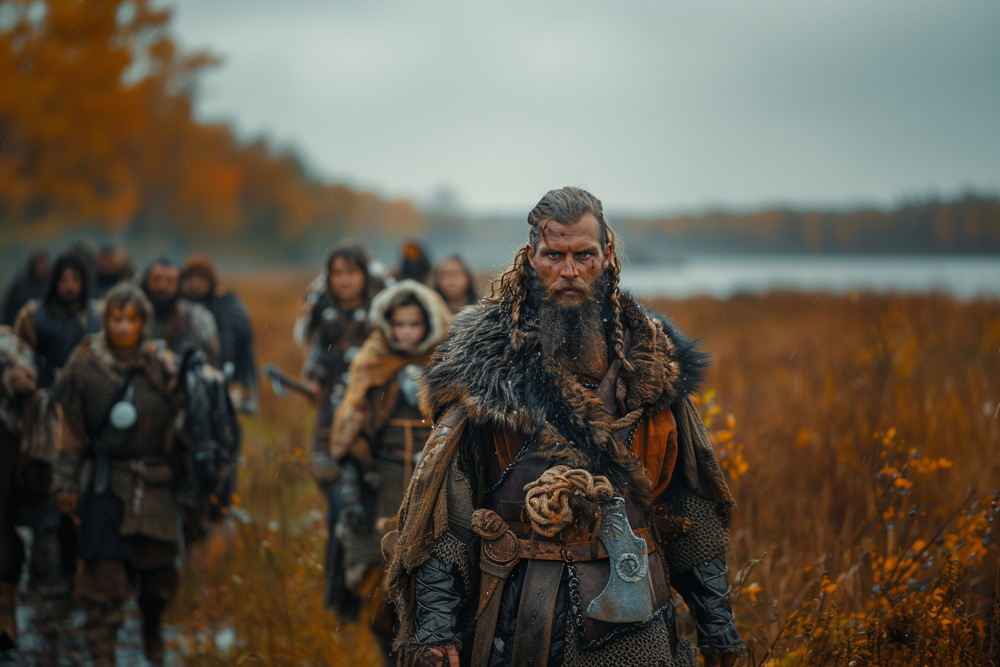
Norse mythology was not an isolated phenomenon. It shared roots in the vast Indo-European cultural trunk with its eastern neighbors, the Slavic peoples. Before their Christianization, the Slavs developed a worldview with notable parallels.
Although the suppression of Slavic paganism was so effective that it did not leave us a canonical cosmogonic text like the Edda, fragments and folkloric reconstructions point to familiar concepts: a god of thunder and order (Perun) who fights the forces of chaos and the underworld, often personified by a serpent god or by Veles, guardian of herds, wealth, and the underworld; a celestial creator deity associated with fire (Svarog) or with a principle of ancestry (Rod); and the belief in a Cosmic Tree that sustains the three worlds.
As among the Norse, the pre-Christian Slavic worldview seems to emphasize a dynamic and often conflictual balance between divine forces, all deeply immersed in and expressed through nature.
A universe of action and consequence
Ultimately, Norse Cosmogony, with its cosmic drama from Ginnungagap to Ragnarök, forges a worldview in which meaning is not given, but conquered through action. The gods are fallible and destined to end, and the universe is a stage of eternal conflict.
In this scenario, the only worthy response is that of the hero — or the common person — who, knowing their fate, chooses to face it with bravery and honor, writing their own saga upon the vast and indifferent canvas of the Norse skies.
Conclusion
Norse Cosmogony has bequeathed to us a vision of the universe as a heroic and tragic conquest. A world forged in ice and fire, born of a primordial sacrifice and inhabited by a humanity that carries within it the divine breath, yet lives in a realm surrounded by danger.
Creation is not an endpoint, but the beginning of a long and tense vigil that will culminate in Ragnarök, where order, knowing itself to be finite, fights bravely against the chaos from which it was born.
This dark, yet deeply poetic and heroic vision of creation and the end of all things represents one of the most striking responses to the mystery of origin.
While the Norse gods prepared for their final destiny in the northern forests, at another end of Europe, among the mysterious Celtic peoples, there flourished a worldview equally magical (Celtic Cosmogony), but deeply connected to the land, natural cycles, and a creation narrative intertwined with the very history of the invasion of Ireland. It is highly recommended as complementary reading!
May the Light of Love be the guide of all paths, at all times, in all circumstances, with all the people. And may Love foster Peace!
Bibliographical references
1. STURLUSON, Snorri. Edda em Prosa. Trad. e notas de Marcelo Magalhães Lima. Ed. Hedra, 2011.
The most important medieval source. This edition includes a solid introduction and notes that help clarify the context.
2. LARRINGTON, Carolyne (Ed.). The Poetic Edda. Oxford World ‘s Classics, 2009.
A collection of the oldest mythological poems, which form the basis of Snorri’s compilation.
3. DAVIDSON, H. R. Ellis. Gods and Myths of Northern Europe. Penguin Books, 1964.
A classic and accessible interpretation of Norse myths, analyzing their themes and meanings.