


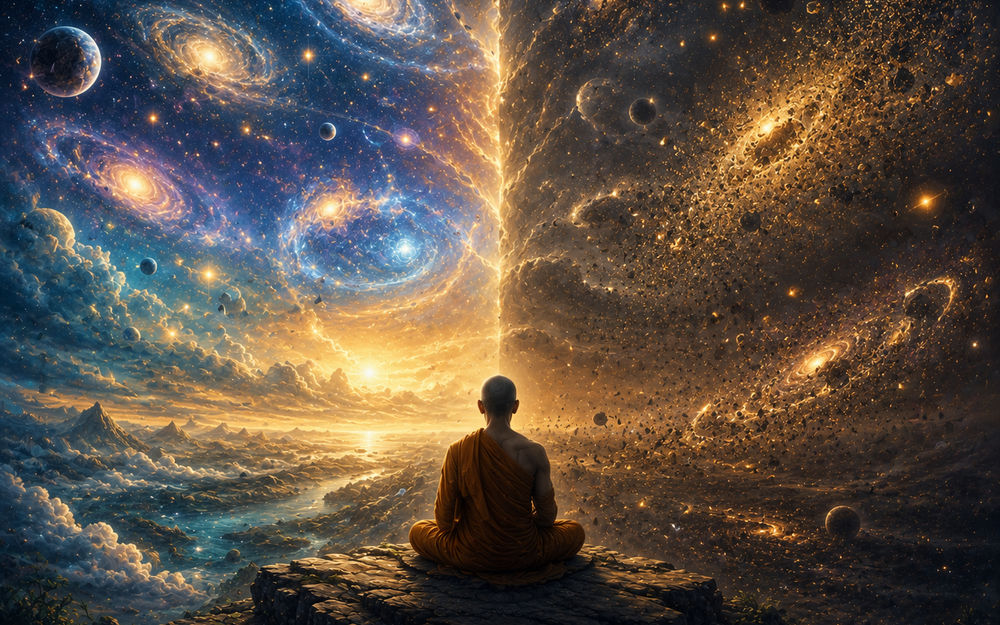
Buddhist Cosmogony presents a unique approach among myths of the origin of the universe, as it shifts the focus from the question of the beginning of everything to what is considered a more urgent issue: the origin of suffering and the path to its cessation.
Rather than seeking a first cause or an absolute creator, the Buddhist tradition emphasizes the interdependence of all phenomena and the cyclical nature of existence. It is a perspective that challenges many of the ideas found in other creation narratives.
In this article, we will explore how Buddhism understands the formation and dissolution of worlds through Dependent Origination (Pratityasamutpada), a universal law of causality. We will examine a worldview in which creation is not a single event, but a continuous process, without an absolute beginning and without a creator god.

The context of Buddhism: the golden Middle Way and the pragmatics of liberation
To understand the Buddhist position on cosmogony, it is essential to understand the context of its foundation and its primary goal within the theological study of salvation:
- The Buddha as a pragmatic teacher: Siddhartha Gautama (5th century BCE) was not a metaphysician or a cosmologist, but a spiritual physician. His mission was to diagnose the universal illness of suffering (Dukkha) and prescribe a practical remedy for its cure. Questions that did not contribute to this objective were considered purposeless;
- The rejection of extremes: The Buddha proposed a “Middle Way” between sensual indulgence and virtuous self-mortification. This middle path also applies to thought. Speculating about an absolute beginning of the world was viewed as a metaphysical extreme that generated attachment to views (ditthi) and, consequently, more suffering;
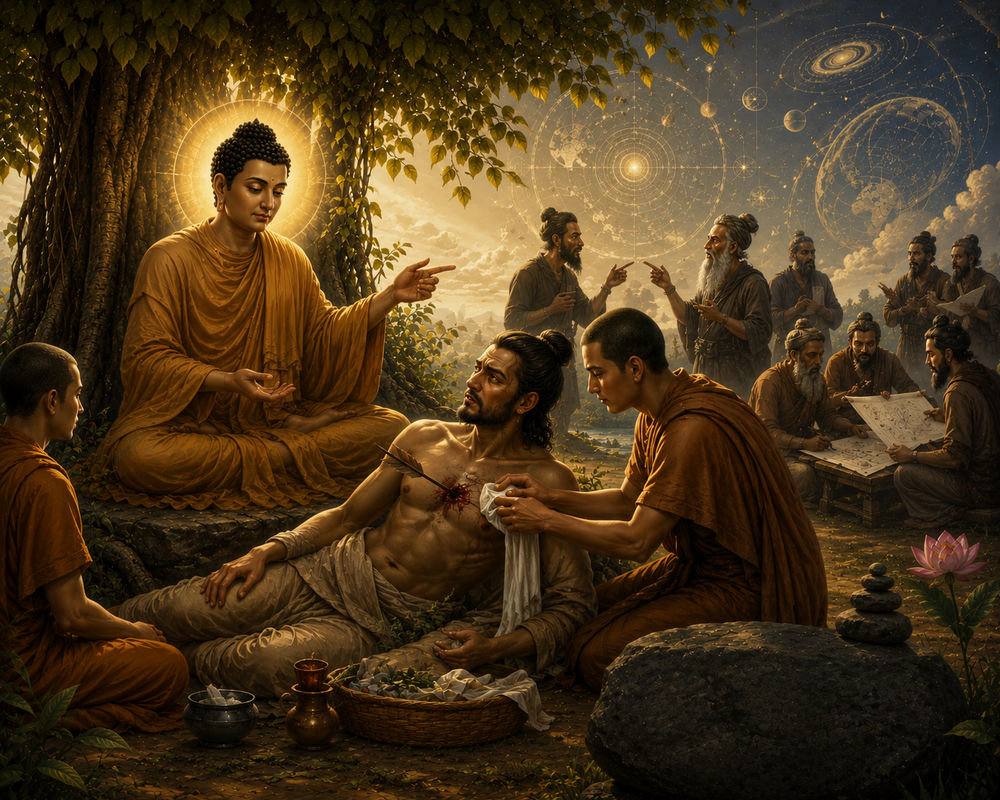
- The fourteen unanswered questions (Avyakata): In several discourses (such as the Cula-Malunkyovada Sutta), the Buddha refuses to answer metaphysical questions, including whether the world is eternal or not, whether it is finite or infinite, and what the exact origin of the world is. His famous parable of the man wounded by an arrow illustrates this point: a man does not ask who shot the arrow, what material it was made from, and so on, before allowing others to remove it and heal the wound. The priority is to remove the arrow of suffering, not engage in fruitless speculation.
The Buddhist approach: dependent origination and cosmic cycles
Although the Buddha rejected cosmogony in the sense of an “act of creation,” Buddhism developed a complex view of the formation and dissolution of world systems based on its central doctrine:
Dependent Origination (Pratityasamutpada): the true “creation”
The principle that replaces any notion of divine creation is Dependent Origination. It states that all phenomena arise in dependence upon causes and conditions. Nothing exists independently; everything is interdependent. This principle is formulated in twelve links (nidanas) that explain the origin of suffering, from ignorance to aging and death.
Although primarily applied to psychological suffering, this principle is cosmic in scope. The formation of a world system (chakravada) is also governed by Dependent Origination. There is no creator, only a vast, impersonal, and continuous process of cause and effect, in which the actions (karma) of all sentient beings constitute a fundamental causal force.
Cyclical cosmology without a beginning (Anadi)
Like Hinduism, Buddhism sees time as cyclical and without a discernible starting point (anadi). Samsara, the cycle of rebirth, suffering, and death, has no known beginning. Countless world systems arise, endure, and dissolve in immensely vast cycles.
- The dissolution and re-formation of a world (Kalpa): A kalpa is a cosmic aeon. After a long period, a world dissolves. First through fire, then through water, and finally through wind, until only a void of potentiality remains. After another long period, conditions begin to gather once more. Beings whose karma leads them to be reborn in that world system begin to reappear there, first in divine realms, and gradually the physical world reforms around them according to their collective karma;
- “Creation” is impersonal and karmic: The “creation” of a new world system is not an act of will, but a natural and karmic process. It is the maturation of the collective karma of beings that drives the re-formation of worlds. Unlike the sacrifice of Purusha, there is no plan or purpose; it is an emergent and conditioned process.
The absence of a creator God (Ishvara)
Buddhism explicitly rejects the notion of an omnipotent and eternal creator god (Ishvara). If such a god existed, the tradition argues, all suffering and imperfection in the world would be his direct responsibility, making him either malevolent or incompetent.
Furthermore, the idea of an eternal and unconditioned entity is incompatible with the central Buddhist doctrine that all phenomena are impermanent (Anicca) and possess no independent self (Anatta). The very idea of a creator is itself a product of causes and conditions — a mental construct.
Analysis and meaning: a universe of process and liberation as the goal
The Buddhist approach to “creation” is deeply consistent with its ethical system and theological study of salvation:
- Focus on ethics and psychology, not cosmology: By shifting attention from the origin of the cosmos to the origin of suffering, Buddhism performs a revolution in religious thought. The most important “creation” is not that of the universe, but the creation of the Noble Eightfold Path leading to Nibbana (Nirvana)—a set of eight practices that lead to the cessation of suffering. The energy that might be spent on cosmogonic speculation is redirected toward ethical and meditative practice;
- An ethical cosmos: The law of Karma, applied cosmically, creates a profoundly ethical universe. The quality of the worlds we inhabit is a direct reflection of the quality of our actions, words, and thoughts. There is no external god to blame or worship; responsibility for our cosmic and individual destiny lies within ourselves;
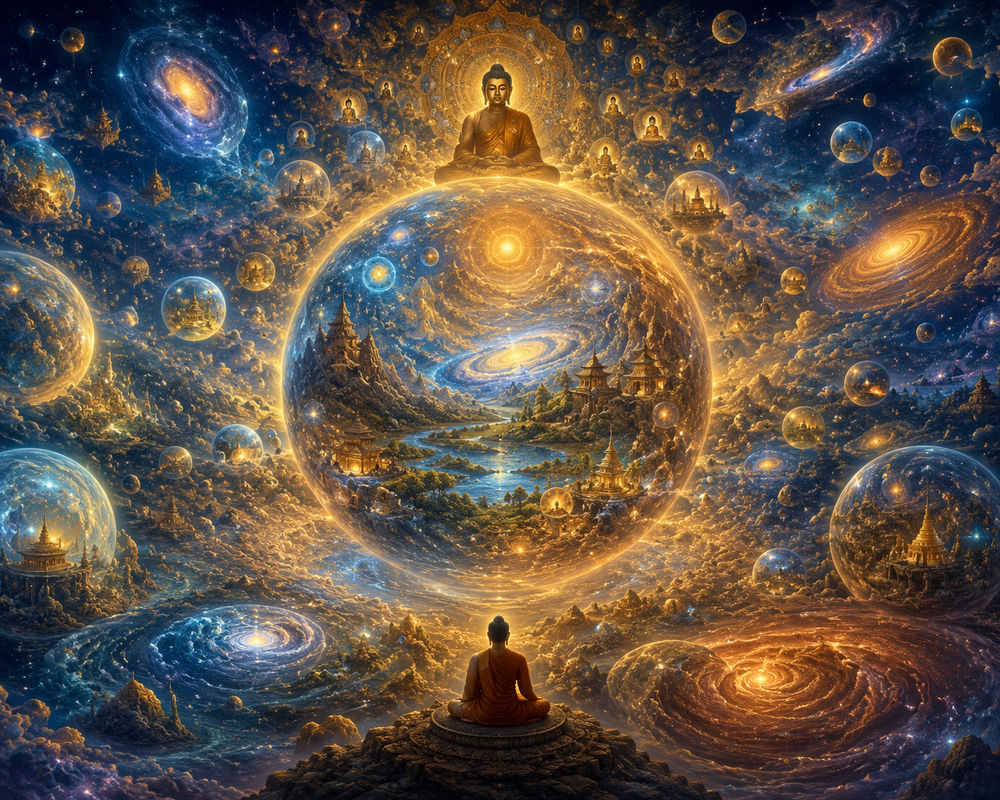
- Impermanence as a cosmic law: The idea that entire universes arise and dissolve is the ultimate expression of Anicca (Impermanence). Nothing—not even galaxies or aeons (vast periods of cosmic time)—escapes this fundamental law. Attachment to anything within this flow, including ideas of a creator or a permanent creation, is itself the root of suffering;
- Contrast with Hinduism: While Hindu Cosmogony seeks unity with an ultimate cosmic reality (Brahman), Buddhism seeks the cessation of the entire process of dependent origination that constitutes Samsara. The goal is not to merge with a creator, but to extinguish the fires of desire that sustain the cycle of rebirth and, therefore, the ongoing “creation” of suffering itself.
Conclusion
Buddhist Cosmogony, or perhaps more accurately, the “Buddhist Non-Cosmogony”, presents us with a universe of pure process, devoid of a divine architect, an ultimate purpose, or an absolute beginning. It is a vast, impersonal, and cyclical cosmos governed by the infallible laws of Karma and Dependent Origination, where the only teleology is that created by the human and non-human aspiration for liberation itself.
By refusing to answer the question “Where did we come from?”, the Buddha was not being evasive; he was pointing toward the only answer that truly matters: “Where can we go, and how can we get there, free from suffering?”
This pragmatic and deeply philosophical perspective offers a unique counterpoint among the various explanations of the origin and functioning of the universe.
For those who wish to deepen this journey, Jain Cosmogony also presents a fascinating vision of reality, marked by cosmic cycles and an extraordinarily elaborate structure of the cosmos.
May the Light of Love be the guide of all paths, at all times, in all circumstances, with all the people. And may Love foster Peace!
Bibliographical references
1. RAHULA, Walpola. What the Buddha Taught. Grove Press, 1974.
A clear and concise presentation of the fundamental teachings of Buddhism, including a crucial chapter on the Buddha’s attitude toward metaphysical questions such as the origin of the world.
2. BODHI, Bhikkhu (Trad. e Ed.). The Connected Discourses of the Buddha (Samyutta Nikaya). Wisdom Publications, 2000.
An authoritative translation of one of the principal Buddhist canons, containing the suttas in which the Buddha discusses the unanswered questions (Avyakata) and the workings of Dependent Origination.
3. KALUPAHANA, David J. A History of Buddhist Philosophy: Continuities and Discontinuities. University of Hawaii Press, 1992.
Traces the development of Buddhist thought, explaining how different philosophical schools addressed (or avoided) cosmological questions.
4. SADAKATA, Akira. Buddhist Cosmology: Philosophy and Origins. Kosei Publishing, 1997.
A study dedicated specifically to the elaborate cosmological models that developed within Buddhism, particularly in the Abhidharma tradition, showing how Dependent Origination was applied on a universal scale.