


The human journey to decipher the origins of the cosmos unfolds through two great narratives: Cosmogony, which, through myths and symbols, explores the profound meaning of existence, and Cosmogenesis, which, through observation and reason, investigates the physical processes of the universe. Hindu Cosmogony presents one of the deepest visions, proposing a cosmos that neither begins nor ends, but manifests itself in continuous cycles of creation, preservation, and dissolution.
Unlike linear narratives, time here is circular, and existence renews itself eternally. This perspective broadens our understanding alongside traditions already explored on the blog, such as Sumerian Cosmogony.
Today, we will explore Hindu Cosmogony from the Vedic hymns to the reflections of the Upanishads, revealing a narrative in which creation, sacrifice, and consciousness intertwine.

The Hindu context: Sanatana Dharma and the structure of cosmic time
To understand how Hindu Cosmogony attempts to explain the origin of the universe, it is essential to comprehend its fundamental assumptions about the nature of time, reality, and the divine:
Sanatana Dharma: the eternal order
Hinduism understands itself as Sanatana Dharma, the “Eternal Order.” This reflects a vision of the universe in which ultimate reality (Brahman) is eternal and unchanging, while the manifested world is cyclical and impermanent.
The cyclicity of time
Cosmic time is organized on almost unimaginable scales. A single cycle of creation and dissolution (kalpa) lasts 4.32 billion years, equivalent to one “day of Brahma.” These cycles repeat infinitely, like the seasons of the year on a cosmic scale.
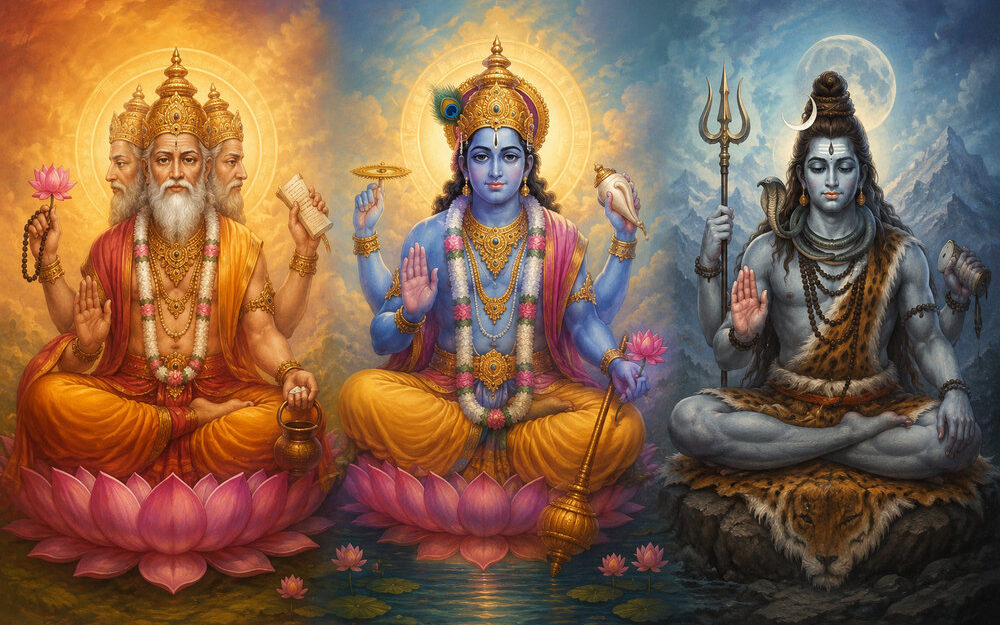
The Hindu trinity (Trimurti) and the phases of the cosmos
Cosmic dynamics are governed by three principal deities:
- Brahma: the creator, responsible for generating the universe in each new cycle;
- Vishnu: the preserver, who sustains cosmic order (dharma);
- Shiva: the transformer, who dissolves the universe at the end of each cycle, allowing for a new beginning.
The four Vedas and the layer of the Upanishads
The foundation of Hindu Cosmogony lies in the Vedas, especially the Rigveda, and its later philosophical elaboration in the Upanishads. This tradition accepts multiple narratives, from the most mythological to the most abstract, as valid paths for understanding the origin of the universe.
The narratives of creation: from doubt to cosmic sacrifice
Hindu Cosmogony offers several creation narratives, each illuminating a different aspect of truth:
Cosmic doubt: the Hymn of Creation (Nasadiya Sukta)
The Rigveda (1500–1200 BC) opens space for a remarkably sophisticated and non-dogmatic cosmogonic reflection in the Hymn of Creation (Nasadiya Sukta, Rigveda 10.129). It begins by describing a state of non-being and being undifferentiated, a primordial unity wrapped in darkness. Then arises the “One,” driven by the power of cosmic heat (Tapas).
However, the hymn culminates in a humble and profound doubt: “Who truly knows? Who can declare it here? From where was it born? From where did this creation come? The gods came afterward, with the creation of this world. Who then knows from where it arose? He from whom this creation arose, whether he formed it or not, he who watches over it from the highest heaven, only he knows – or perhaps even he does not know.”
This hymn establishes a tone of mystery and inquiry, accepting the limits of both human and divine knowledge regarding the ultimate origin.
Cosmic sacrifice: the Hymn of Purusha (Purusha Sukta)
In contrast to the abstraction of the Nasadiya Sukta, the Hymn of Purusha (Purusha Sukta, Rigveda 10.90) offers a vivid and seminal image: creation as sacrifice. Purusha is a primordial cosmic being, with a thousand heads, a thousand eyes, and a thousand feet, permeating all creation. The gods perform a ritual sacrifice and dismember him. From his bodily parts, the universe is formed:
- His mouth becomes the priest (Brahmana);
- His arms become the warrior (Kshatriya);
- His thighs become the merchant (Vaishya);
- His feet become the servant (Shudra);
- His mind generates the moon, his eye the sun, his breath the wind, and his skull the sky.
Here, creation is simultaneously social and cosmic, establishing both the natural order and the social order (the varna system) at once from the body of a single being. Sacrifice (yajna) becomes the founding act of the cosmos.
Emanation from Brahman
In the Upanishads (from around 800 BC onward), cosmogony becomes more philosophical. Ultimate reality is Brahman, the impersonal, absolute, and ineffable principle that is the basis of everything. The manifested universe is an emanation or appearance (maya) of Brahman.
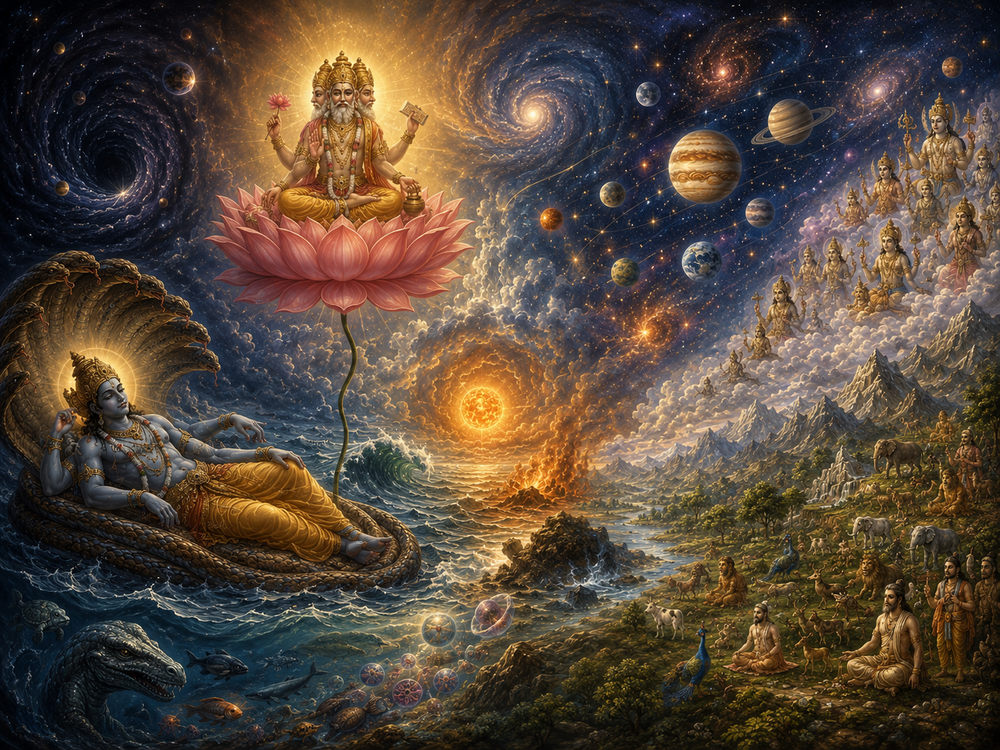
In some narratives, the personal creator god, Brahma, emerges from a lotus growing from the navel of Vishnu, who rests upon the cosmic serpent Shesha in the primordial ocean of milk. This image illustrates the idea that the act of creation is an event occurring within divine reality, and not ex nihilo (from Nothing).
If you are enjoying exploring Hindu Cosmogony, take the opportunity to also read about other cosmogonies, such as Maori Cosmogony and Jain Cosmogony, and further expand your understanding of how different cultures interpret the origin of the universe.

Analysis and meaning: a cyclical cosmos and fundamental unity
Hindu Cosmogony reveals a profoundly coherent worldview with vast philosophical implications.
- A universe without an absolute beginning (Anadi): unlike the Abrahamic cosmogonies, the Hindu universe is anadi (without beginning). The question “What existed before?” is answered with the idea of infinite cycles. This removes the need for a “first cause” in the linear sense, focusing instead on eternal processes of transformation;
- The unity of macrocosm and microcosm: the sacrifice of Purusha establishes an intimate connection between the structure of the universe (macrocosm) and the structure of society and the individual (microcosm). Everything is interconnected because everything originated from a single being. This fundamental unity is at the heart of Upanishadic philosophy: Atman (the individual Self) is ultimately identical to Brahman (cosmic reality);
- Creation as Lila (Divine Play): a reason often given for creation is Lila, the divine “play” or “dance.” The universe is not created out of necessity, but as a spontaneous expression of Brahman’s joy and creativity. This grants a certain lightness to existence, though within a rigorous framework of dharma (order/duty);
- The role of knowledge (Jnana) in the “reversal” of creation: the spiritual goal in Hinduism is not merely to understand creation, but to transcend the illusion of separation (maya) and realize unity with Brahman. In a certain sense, the spiritual journey is a reversal of the cosmogonic process — a return from multiplicity to unity, from manifestation to the unmanifest source.
Conclusion
Hindu Cosmogony presents us with an infinitely ancient and constantly renewing universe, born from primordial sacrifice and manifested as an expression of ultimate reality. It is a vision that embraces mystery, values multiplicity, and at the same time points toward an essential unity that sustains all existence.
Creation ceases to be an isolated event in the past and becomes understood as a continuous process in which we are all immersed — and from which we may liberate ourselves through self-knowledge.
This cyclical and deeply philosophical perspective is one of the great pillars of human thought. To broaden this perspective on how different cultures explain the origin of the universe, it is also worth exploring Buddhist Cosmogony and Aztec Cosmogony, which offer distinct and equally fascinating approaches to the subject.
I’ll see you in our next adventure!
May the Light of Love be the guide of all paths, at all times, in all circumstances, with all the people. And may Love foster Peace!
Bibliographical references
1. DONIGER, Wendy (Trad. e Ed.).The Rig Veda: An Anthology. Penguin Classics, 1981.
An accessible and annotated translation that includes the fundamental cosmogonic hymns, such as the Nasadiya Sukta and the Purusha Sukta, with contextual commentary.
2. ZAEHNER, R. C. Hindu Scriptures. Everyman’s Library, 1992.
An anthology bringing together extracts from the Vedas, Upanishads, and other texts, providing a comprehensive overview of the development of Hindu cosmogonic thought.
3. KLOOSTERMAN, Anna. The Cosmogony of the Bhagavata Purana: Where the Journey Begins. Routledge, 2023.
A study focused on the cosmogony of a crucial Puranic text, showing the evolution of Vedic ideas into elaborate narratives.
4. BASHAM, A. L . The Wonder That Was India. Sidgwick & Jackson, 1954.
A classic work providing the historical and cultural background necessary to understand the development of Hindu religion and philosophy, including its ideas about creation.