


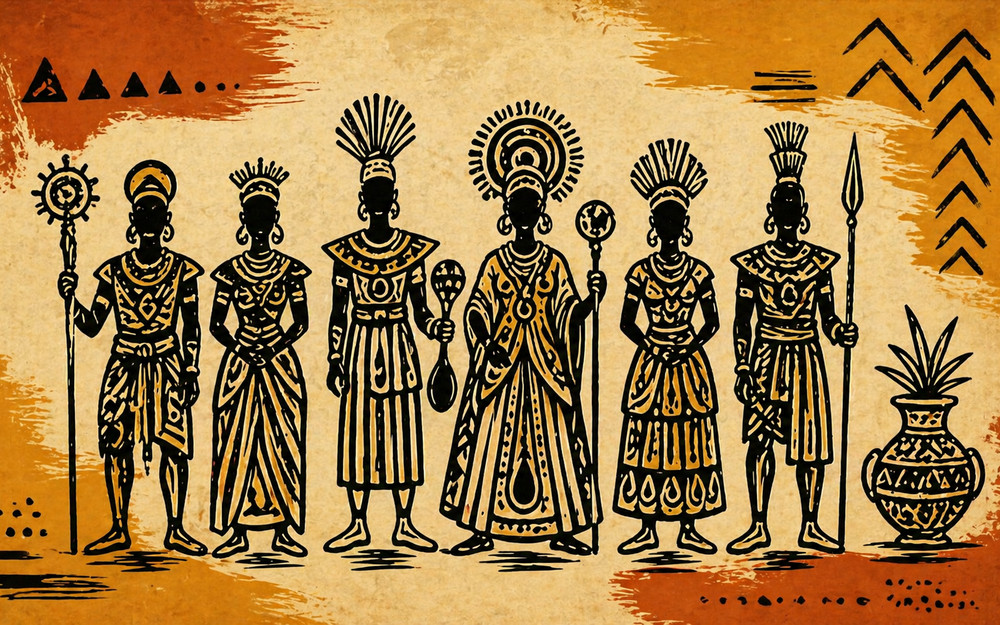
The Yoruba Cosmogony reveals one of the richest ways of understanding the myths of the origin of the universe, combining symbolism, spirituality, and worldview into a profound narrative about creation. Unlike other traditions marked by conflicts or conquests, here we find a conscious and organized process, guided by a divine force that shapes the world with intention and balance.
In this article, I will present the main elements of this tradition, exploring the role of Olodumare, the Supreme God, and the mission of Oduduwa in the formation of the Earth in Ilê-Ifé. More than explaining the origin of the world, this cosmogony establishes the foundations of the relationship between the human, the divine, and existence itself.

The Yoruba world: context and structure of the cosmos
To understand the Yoruba Cosmogony, it is essential to grasp its hierarchical worldview strongly based on balance.
A complex and urban society
The Yoruba civilization was historically organized into powerful city-states (such as Ifé, Oyo, and Benin), with a complex social structure and a sophisticated artistic tradition (notably the Ifé bronzes). This is reflected in a cosmogony that is itself well structured and organized.
The spiritual hierarchy
The Yoruba pantheon is clearly organized:
- Olodumare/Olorun: the Supreme God, transcendent, uncreated, and omnipotent. He is the ultimate source of all authority and cosmic energy (axé), but remains distant from everyday affairs;
- The Orishas (Òrìṣà): deities who act as intermediaries between Olodumare and the world. They are emanations or aspects of the divine, each governing a force of nature (such as thunder, with Xangô), a concept (such as wisdom, with Orunmilá), or a human activity (such as hunting, with Oxóssi). They are the main agents of creation and rulers of the world;
- Ancestral spirits: the eguns, spirits of the ancestors who maintain a bond with the community of the living.
The concept of Axé (Àṣẹ)
Axé is the vital force, the power to make things happen, the energy that sustains creation. Everything in the universe possesses axé in varying degrees. Rituals and offerings aim to strengthen and channel axé to maintain cosmic order and harmony.

The creation narrative: the mission of Oduduwa in Ilê-Ifé
There are variations in the narrative, but the central core involves the descent from heaven and the creation of solid land.
The primordial state: heaven and the primordial waters
In the beginning, there was only Heaven (Orun) and a vast primordial ocean of still and muddy waters (or, in some versions, an infinite desert). Life existed only in Heaven, with Olodumare and the Orishas.
The divine mission: the descent and the creation of Earth
Olodumare decided to create Earth (Ayé). For this, he summoned Oduduwa (or, in more common versions, Obatalá), one of the primordial Orishas. Olodumare gave him sacred instruments for creation:
- A snail shell containing fertile soil;
- A five-toed hen;
- A pigeon;
- An acorn (in some versions);
- A golden chain.
Oduduwa/Obatalá descended from heaven using the golden chain, arriving at what would become Ilê-Ifé (“The House that is Spread Out” or “The House of Love”). Finding only primordial waters, he poured the soil from the shell onto the water’s surface. Then he released the hen and the pigeon.
The birds immediately began to scratch and spread the soil, which expanded in all directions, forming solid land (Ilê). The acorn was planted and grew into a great tree that pierced the sky, establishing a permanent connection between Orun (Heaven) and Ayé (Earth).
The Oduduwa version: decisive intervention
In an alternative and highly meaningful version, Obatalá is assigned the mission, but along the way encounters a celebration and becomes intoxicated with palm wine. Falling asleep, he is unable to complete the task. Oduduwa, realizing this, takes the instruments and successfully completes the mission.
This version is crucial because it:
- Explains divine fallibility: even the Orishas can err, bringing them closer to the human condition and warning against excess, especially alcoholism;
- Establishes Oduduwa’s sovereignty: justifies why Oduduwa is considered the founder of earthly royalty in Ifé and progenitor of Yoruba kings, while Obatalá remains the creator of human bodies and the Orisha of purity (though he failed in a crucial mission).
The creation of humanity
With solid land established, Olodumare decided to populate it. The task of shaping the physical bodies of the first humans was given to Obatalá (or Oxalá in some versions). Using clay, he carefully molded human figures.
Then Olodumare breathed the emí (the breath of life, spirit) into them, giving them life. As the sculptor of humanity, Obatalá is also the protector of those born with physical defects, since his creations were not always perfect—especially when he worked while intoxicated.
The mission of Orunmilá and the wisdom of destiny
At the same time, Olodumare sent Orunmilá (also known as Ifá), the Orisha of wisdom, prophecy, and divination, to Earth. His mission was to bring knowledge of each individual’s destiny (ipin or ori). Orunmilá descended carrying the Ifá divination system, allowing humans to consult and understand their destiny, seeking to live in harmony with Olodumare’s will.

Analysis and meaning: order, fallibility, and collective axé
The Yoruba Cosmogony reveals a deeply philosophical and practical worldview:
- Creation as an act of order and expansion: unlike myths that involve extreme violence, Yoruba creation is a constructive and peaceful process. The image of the hen scratching the earth is powerful: order emerges not from destruction, but from an act of patience and meticulous work that transforms aquatic chaos into a solid and habitable foundation;
- Divine fallibility and human responsibility: the myth of Obatalá’s intoxication is crucial. It introduces the notion that even the gods can make mistakes. This humanizes the divine and serves as a powerful warning against excess, especially alcoholism. It also suggests that creation, although of divine origin, is a process that can be marked by imperfections, which is reflected in the human condition;
- Division of tasks and the importance of community: creation is not a solitary act of a single god. It involves Olodumare (the supreme authority), Oduduwa/Obatalá (the physical executor), the animals (the hen and the pigeon as essential collaborators), and Orunmilá (the bearer of spiritual wisdom). This reflects a strong communal social value: great achievements are accomplished together, with each contributing their specific role;
- Ilê-Ifé as a cosmic center: like Jerusalem or Mecca, Ilê-Ifé is not just a historical city; it is the navel of the world, the starting point of creation. It is the place where heaven literally touched the earth, establishing it as the spiritual and political center from which all Yoruba royalty emanates.
Conclusion
The Yoruba Cosmogony offers us a vision of creation as a deliberate, communal, and ordered act. A world brought into existence not by brute force, but by the power of divine axé, carried out with simple tools and the help of the animal world, and finally inhabited by a humanity that carries within it the breath of Olodumare and the care (and at times the failure) of Obatalá.
It is a narrative that emphasizes responsibility, destiny, and the sacred interconnection between all levels of existence, from the Supreme Creator to the humblest creatures.
This vision of an organized, community-based creation, centered on a sacred city, reveals one facet of the rich tapestry of African mythology, which also encompasses Dogon Cosmogony and Coptic Cosmogony.
Keep following the blog to learn how different cultures explain the origin of the universe. See you next time!
May the Light of Love be the guide of all paths, at all times, in all circumstances, with all the people. And may Love foster Peace!
Bibliographical references
1. IDOWU, E. Bolaji. Olodumare: God in Yoruba Belief. Wazobia, 1994.
Considered a classic on Yoruba religion, it offers a detailed analysis of the concept of Olodumare and the structure of the pantheon.
2. ABIMBOLA, Wande. Ifá: An Exposition of Ifá Literary Corpus. Oxford University Press Nigeria, 1976.
Written by a renowned Babalawo and scholar, it provides deep and authentic insight into the Ifá corpus, where many of these narratives are preserved.
3. BASCOM, William. Ifa Divination: Communication Between Gods and Men in West Africa. Indiana University Press, 1969.
A fundamental anthropological study documenting the practice and mythology of the Ifá system, including creation stories.
Excelente artigo!! Tudo absolutamente novo pra mim.
Olá Luciana, obrigado por sua presença e participação no site. Fico feliz que esteja gostando dessa série de artigos sobre as Cosmogonias. Continue acompanhando, pois cada uma das Cosmogonias nos apresenta uma visão de mundo bastante diferente e interessante. Em breve, baseado na mesma pesquisa, vou lançar uma série de vídeos sobre o mesmo assunto e, também, um e-book super completo com muitíssimas informações adicionais e inéditas.
Aproveito esta ocasião para te informar que você pode receber GRATUITAMENTE o meu e-book sobre “10 práticas essenciais para ampliar sua consciência e espiritualidade”. Basta preencher o formulário que está na seguinte página:
https://angelopiovesan.com/news
Abraço fraterno.