


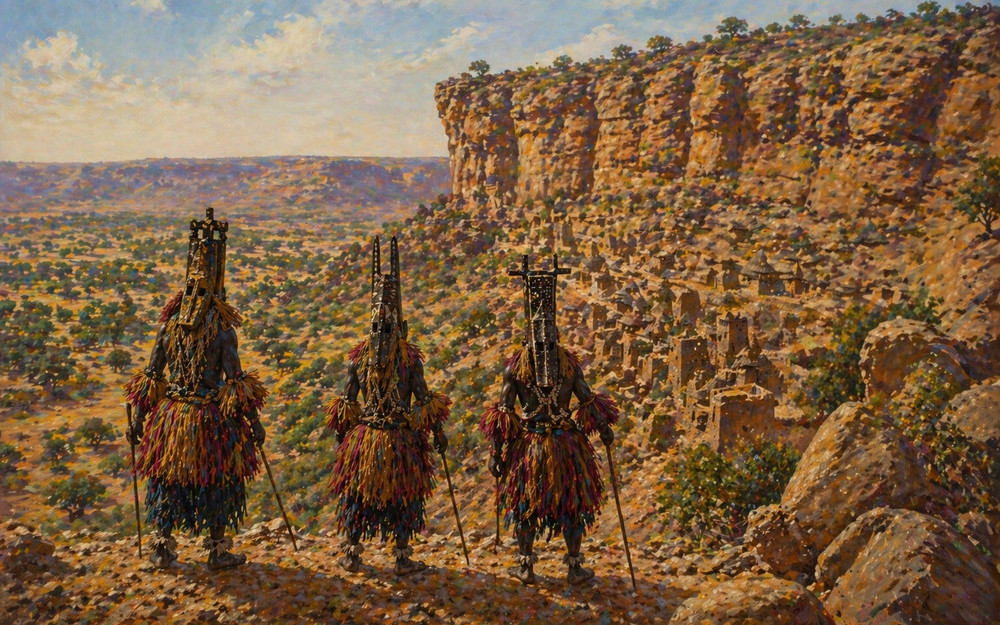
Dogon Cosmogony reveals one of the most fascinating visions among the myths of the origin of the universe, uniting spirituality, symbolism, and a surprising astronomical knowledge.
Unlike other traditions, it is not merely about explaining how everything began, but about understanding the balance between cosmic forces. Among the cliffs of Bandiagara, in Mali, the Dogon people developed a narrative rich in meaning, involving vibrations, order, and universal consciousness.
In this article, I present Dogon Cosmogony as a profound system that integrates myth, philosophy, and observation of the cosmos, highlighting Amma, the “egg of the world,” and the principles that govern creation.

The Dogon world: the context and structure of an initiatory knowledge
To understand Dogon Cosmogony, it is essential to appreciate the nature of its transmission and the depth of its symbolism.
- A society with esoteric knowledge: the complete cosmogonic knowledge of the Dogons is not public. It is initiatory wisdom, gradually transmitted throughout life by a caste of priests (Hogon) to worthy men. This means that the cosmogony operates on multiple levels of interpretation, from popular myth to the highest philosophical abstractions;
- The importance of language and symbol: for the Dogons, language itself and graphic symbols (such as their famous sand drawings) possess creative and revelatory power. The structure of their language (the Dogo-so language) is seen as a reflection of the structure of the universe;
- The concept of Arou: the principle of everything, for the Dogons, is Arou, which may be understood as the divine “Will” or “Project” of Amma. It is the ordering force prior to any manifestation, containing within itself the blueprint of all creation.
The narrative of creation: vibration, revolt, and sacrifice
Dogon creation is a process that unfolds in distinct stages, from primordial unity to the complexity of the present world:
The primordial state: Amma and the egg of the world
In the beginning, there was only Amma, the unique, uncreated, and omnipresent god. Amma was a perfect unity, a “seed” (kize uzi) at the primordial point of the universe. Within himself, he contained the potential of all things.
Amma decided to create the universe. His first action was to conceive an egg (aduno talu), the “Egg of the World.” Within this egg, he placed, in potential form, the eight fundamental “progenitors” of creation, organized into four pairs of twins. These are the spiritual ancestors of all life, collectively known as the Ogdoad (the eight).
The disturbance of order: the revolt of Ogo
Inside the egg, one of the twins, Ogo (also called Nommo die, the imperfect Nommo), became impatient and rebellious. He sought to create a universe of his own, independent of Amma. In his revolt, Ogo stole a fragment of the egg’s placental sac (the future earth) and escaped into space, initiating a disordered and chaotic revolution.
This act of Ogo is the origin of imbalance, chaos, and evil in the universe. Amma’s perfect creation was corrupted from within. To contain the chaos initiated by Ogo, Amma was forced to sacrifice another of the twins, the Nommo (the perfect twin, also called Nommo titiyayne).
The Nommo was dismembered, and his body was spread throughout the universe to stabilize and purify it from Ogo’s chaos. This primordial sacrifice is the archetype of all Dogon sacrifices and rituals, which aim to restore cosmic order.
The creation of Earth and the arrival of the Ark
Amma then transformed the body of Ogo, who had failed in his independent creation, into the planet Earth (Arou). However, the Earth, created from rebellion, was initially sterile and dry.
To complete creation and bring life, Amma sent an Ark (aduno koro) to Earth. This ark, piloted by the seven remaining Nommo (the other twins, now complete after the sacrifice), descended from the heavens carrying all the foundations of human civilization: grains, animals, weaving techniques, metallurgy, and, above all, the word (language).
The Ark landed on Earth, and the Nommo became the masters and civilizers of humanity, teaching people everything necessary to live in a world that, although marked by Ogo’s revolt, could be fertilized and ordered through sacred knowledge.

Analysis and meaning: a cosmos of language and astronomical precision
Dogon Cosmogony reveals an incredibly sophisticated worldview, where myth and celestial observation merge.
Creation as an Act of Language and Mathematics
Amma’s creative act is described as a “vibration” or an “inner word.” The universe emerges from a primordial oscillation, an idea that resonates with concepts of modern physics. The organization of the progenitors into pairs of twins reflects a vision of the cosmos based on dualities and complementary balances (masculine/feminine, etc.).
The mystery of Sirius and astronomical knowledge
The most astonishing element of Dogon Cosmogony is its detailed knowledge of the Sirius system. The Dogons claim that Sirius (sigi tolo) is a triple star system, and they accurately describe:
- The main star, Sirius A.
- Sirius B (po tolo – “the fonio seed star”), an extremely dense white dwarf star invisible to the naked eye, whose existence was only confirmed by Western astronomy in 1862, and whose 50-year orbit they already knew.
- Sirius C (emme ya tolo – “the female sorghum star”), a smaller star whose existence is still hypothetical for science, but for which the Dogons provide orbital details.
- How could a people without advanced optical instruments possess such knowledge? Explanations range from ancient observations and extraordinary cultural transmission to hypotheses of external contact, but the fact remains a testament to the depth of their cosmological system.
Sacrifice as the foundation of order
As in other traditions (Purusha in India, Ymir in Scandinavia), Dogon creation involves a cosmic sacrifice (that of the Nommo). Order and life are only possible through this act of self-offering that contains and purifies chaos (Ogo). Existence is therefore a dynamic and fragile balance between the order of Amma and the disorder of Ogo.
A cyclical view of time
Dogon Cosmogony is linked to a 60-year cosmic cycle, marked by the Sigi ceremony, which celebrates the renewal of the world and is connected to the orbital period of Sirius B. Creation is not a single event, but a process that must be ritually renewed and sustained.

Conclusion
Dogon Cosmogony reveals to us a universe born from unity, passing through imbalance, and finding harmony again through a restorative principle.
I see here a narrative of extraordinary symbolic depth, one that not only expresses a spiritual vision of the world, but also suggests a careful and sophisticated observation of the sky and its cycles. The knowledge associated with Sirius, in particular, remains an invitation to reflect on the boundaries between myth, observation, and human intuition.
This reading shows us a living cosmos, governed by relationships, rhythms, and complementary forces. To broaden this perspective on myths about the origin of the universe, I also recommend exploring, as complementary readings, Coptic Cosmogony, Buddhist Cosmogony, and Shinto Cosmogony — each offering new keys to understanding existence.
See you next time!
May the Light of Love be the guide of all paths, at all times, in all circumstances, with all the people. And may Love foster Peace!
Bibliographical references
1. GRIAULE, Marcel; DIETERLEN, Germaine. The Pale Fox. Continuum Foundation, 1986.
Seminal and most detailed work, the result of decades of research and initiation, in which Dogon Cosmogony is presented in its full complexity, including its fundamental diagrams and symbols.
2. GRIAULE, Marcel. Conversations with Ogotemmêli: An Introduction to Dogon Religious Ideas. Oxford University Press, 1965.
A classic and accessible account of Griaule’s dialogue with the wise blind hunter Ogotemmêli, who first revealed the deep structure of Dogon Cosmogony to an outsider.
3. TEMPLE, Robert K. G. The Sirius Mystery. Destiny Books, 1976.
A controversial book that popularized Dogon knowledge about Sirius and speculated about possible extraterrestrial or lost-civilization origins. It should be read critically, but it was fundamental in spreading awareness of the mystery.
4. VAN BEEK, Walter E. A. “Dogon Restudied: A Field Evaluation of the Work of Marcel Griaule”. In: Current Anthropology, 1991.
An important anthropological article offering a critical perspective and revisiting Griaule’s claims, debating the accuracy of his interpretations and the nature of Dogon knowledge. Essential for a balanced understanding.