


Jain Cosmogony presents one of the most original visions of the structure of the universe, describing an eternal reality that was not created by any god and that operates according to impersonal and immutable laws.
Among the many answers to the question of how different cultures explain the origin of the universe, Jainism stands out for asserting that the cosmos has always existed, composed of fundamental substances that continuously reorganize themselves throughout infinite cycles of time.
In this article, we will explore the cosmic principles of Jainism, a tradition that values non-violence (Ahimsa) and developed a cosmology of remarkable conceptual richness. We will discover a self-sufficient universe populated by countless souls seeking liberation through knowledge and individual effort.

The Jain context: non-theism, asceticism, and a scientific worldview
To understand Jain Cosmogony, it is essential to appreciate its rationalist structure and its emphasis on individual responsibility:
- A non-theistic tradition: Jainism does not posit a creator, omnipotent, and omnipresent god (Ishvara). Divine beings (Tirthankaras), such as Mahavira, are human souls who attained perfection and liberation (Kaivalya). They do not create or govern the world; they are teachers and examples. The universe functions according to its own immutable laws;
- The emphasis on knowledge and right conduct: the path to liberation in Jainism is based on the Three Jewels: Right Faith, Right Knowledge, and Right Conduct. Knowledge of the true nature of reality (including cosmology) is considered essential for overcoming the ignorance that binds the soul;
- A detailed cosmic model: Jain texts, such as the Tattvartha Sutra, describe the universe (Loka) with astonishing detail, including its dimensions, the location of various realms of existence, and the meticulous classification of all living beings. This precision reflects a worldview that seeks to map reality in a systematic and logical manner.
The structure of the cosmos: the six eternal substances (Dravyas)
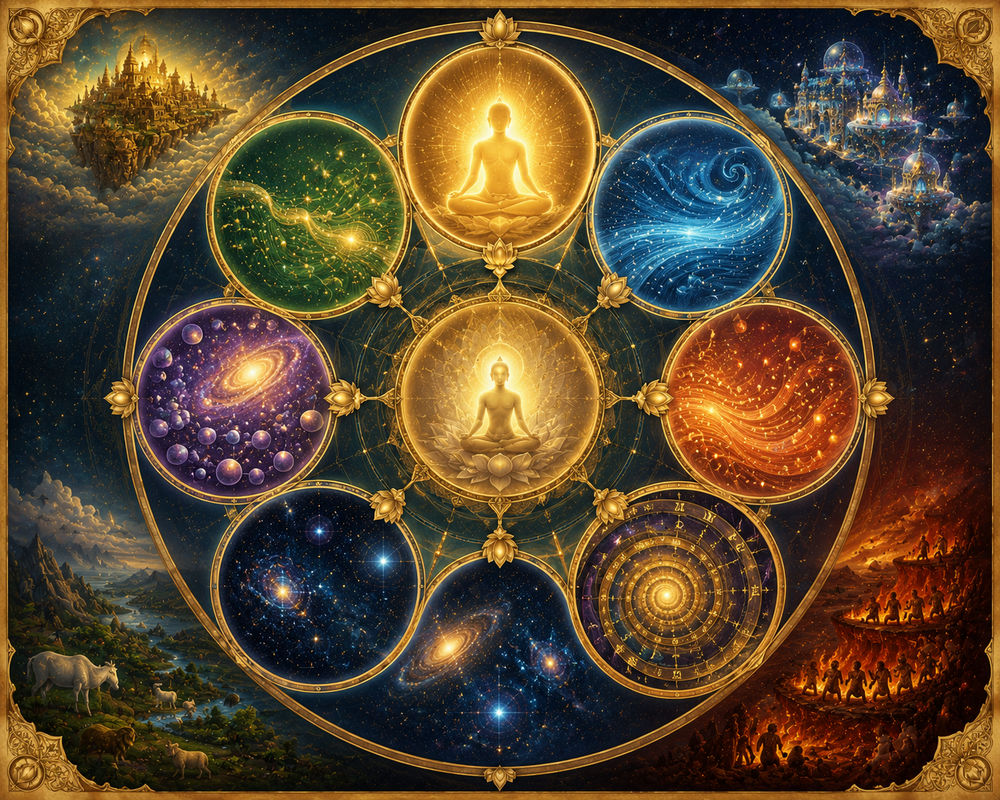
The foundation of all Jain reality lies in six fundamental substances (Dravyas) that are eternal yet subject to modification:
- Jiva (Soul): the conscious substance, eternal and infinite in number. Each individual jiva is a pure, omniscient, blissful, and peaceful being in its natural state. However, in its conditioned state, it is trapped in the cycle of rebirths.
- Ajiva (Non-Soul): an umbrella term for the five unconscious substances:
- Pudgala (Matter): the only tangible substance, formed by atoms (paramanu). It constitutes the body, objects, and even the subtle forms of karma.
- Dharma (Medium of Motion): a subtle and immaterial substance that enables the movement of souls and matter throughout the universe. It is analogous to a medium, such as water for a fish.
- Adharma (Medium of Rest): the complementary substance that enables rest and stability.
- Akasha (Space): the substance that provides the space for all other substances to exist. It is divided into Loka (the cosmos where life exists) and Aloka (the infinite void beyond it).
- Kala (Time): the substance that makes change, continuity, and cycles possible.
The interaction between Jiva (the soul) and Pudgala (karmic matter) is the driving force of samsara. Karma is not an abstract principle but a real, though subtle, form of matter (Pudgala) that adheres to the soul, making it heavier and determining its future experiences.
The shape of the cosmos (Loka) and the cycles of time
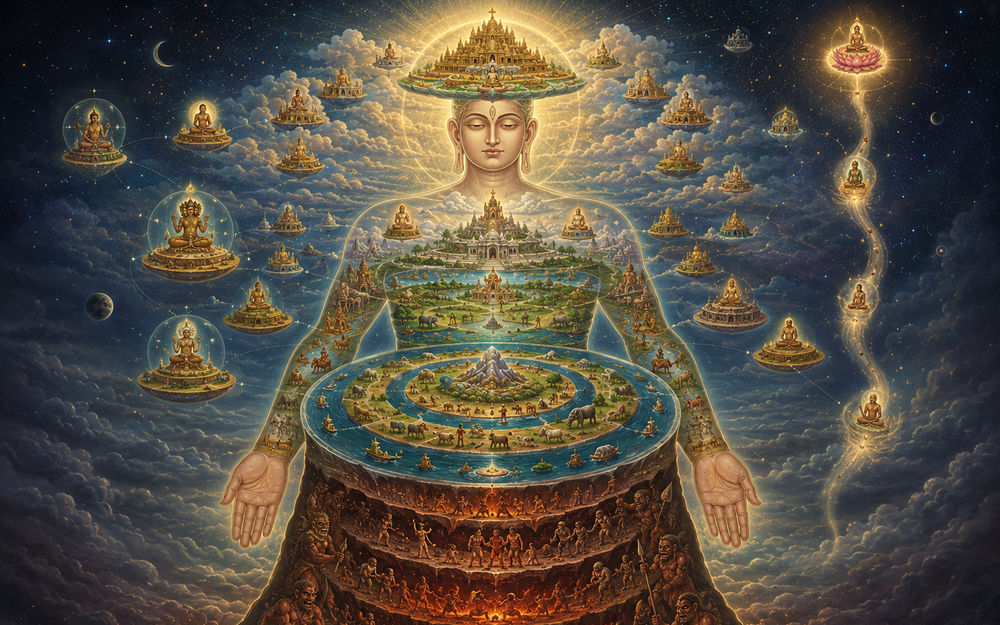
The Jain universe (Loka) is neither a disk nor a sphere but has the shape of a gigantic standing human figure, a cosmic anthropomorphic form.
The structure of Loka
It is divided into three main parts:
- Urdhva Loka (Upper World): the heavenly realms, where souls enjoy pleasures but are not yet liberated.
- Madhya Loka (Middle World): the world of humans and animals, where liberation is possible. It is represented as a series of concentric continents separated by oceans.
- Adho Loka (Lower World): the infernal realms of suffering and darkness.
At the top of the Urdhva Loka lies the Siddhashila, the abode of the liberated, where perfected souls dwell in a state of eternal happiness and peace, immune to any further rebirth.
The cycles of time (Kalachakra)
As in Hinduism and Buddhism, time is cyclical. Each complete cycle (Kalpa) is divided into two halves of descending and ascending ages (Avasarpini and Utsarpini). Each half contains six eras, which witness changes in the happiness, longevity, and moral stature of humanity. We are currently living in a descending era (Avasarpini), marked by gradual decline.
Analysis and meaning: an autonomous universe and the ethics of liberation
Jain Cosmogony offers a worldview that is profoundly coherent, ethical, and empowering:
- A self-regulating cosmos without a creator: the Jain vision is one of the most consistent non-theistic systems ever conceived. The universe is a closed and self-sufficient system, operating according to intrinsic natural laws (the six substances and their interactions). There is no room for divine intervention or grace. Responsibility for the destiny of the soul lies entirely with the individual.
- The materiality of karma and non-violence (Ahimsa): by understanding karma as a real physical substance that clings to the soul, Jainism provides a physical and metaphysical basis for its supreme ethical emphasis on Ahimsa. Every act of violence, no matter how small, generates heavy and adhesive karma that binds the soul. The rigorous practice of non-violence—in thought, word, and action—is therefore an active purification of the soul, preventing new karmic matter from attaching itself and helping to burn away existing karma.
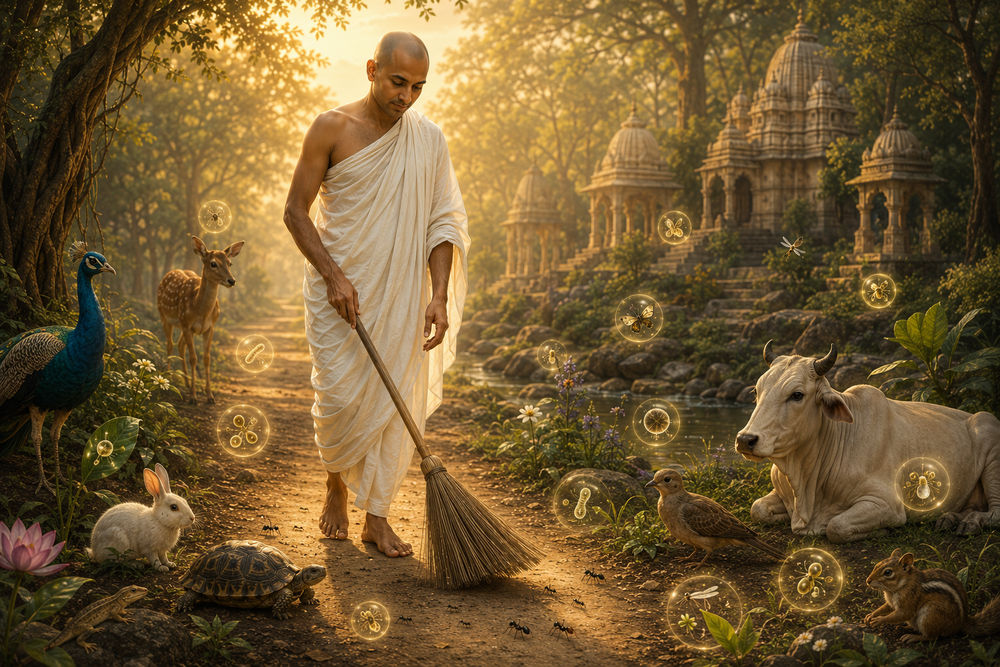
- The interconnectedness of all life: the belief that jivas (souls) are present not only in humans and animals but also in plants, fire, water, and even air leads to a radical environmental ethic. Jain asceticism, which includes filtering water to avoid killing microorganisms and sweeping the ground before walking, is a practical expression of this cosmology.
Contrast with Hinduism and Buddhism
Versus Hinduism: Jainism rejects both a creator god (Brahma) and an ultimate impersonal reality (Brahman). The Jain universe is pluralistic (many eternal souls) and realist (matter is real), in contrast to the monistic idealism found in some Hindu schools.
Versus Buddhism: Jainism agrees with Buddhism regarding the absence of a creator god and the importance of karma. However, Jainism believes in an eternal and permanent soul (jiva), in contrast to the Buddhist doctrine of Non-Self (Anatta). Furthermore, Jainism offers a far more detailed and fixed cosmological map than Buddhism.
Conclusion
Jain Cosmogony presents us with an eternal, structured universe governed by its own laws, composed of souls and substances that continuously interact in cycles without beginning or end.
It is a vision that combines philosophical rigor, ethical responsibility, and a profound reverence for life, placing non-violence at the center of existence. Creation, in this context, is not an isolated event but a permanent rearrangement of elements that have always existed.
Among the many myths of the origin of the universe and cosmological systems developed by humanity, Jainism occupies a unique place by completely dispensing with the figure of a creator and attributing to reality itself the capacity to sustain and transform itself.
To expand this reflection, it is also worth exploring Chinese Cosmogony, Mayan Cosmogony, and Inca Cosmogony, which offer quite different interpretations of the formation and organization of the cosmos.
May the Light of Love be the guide of all paths, at all times, in all circumstances, with all the people. And may Love foster Peace!
Bibliographical references
1. TATTVARTHA SUTRA. That Which Is. Trad. de Nathmal Tatia. HarperCollins, 1994.
The most important Jain canonical text, systematically establishing the principles of reality, including the six substances and the structure of the cosmos.
2. DUNDAS, Paul. The Jains. Routledge, 2002.
A comprehensive and accessible academic study of Jain history, philosophy, and practices, including a chapter dedicated to its complex cosmology.
3. JAINI, Padmanabh S. The Jaina Path of Purification. Motilal Banarsidass, 1979.
A classic work detailing the Jain spiritual path, explaining how cosmology and the understanding of karma are directly related to ascetic practices aimed at liberation.
4. SHAH, Natubhai. Jainism: The World of Conquerors. Motilal Banarsidass, 2004.
A detailed text covering all aspects of Jainism, including diagrams and in-depth explanations of the cosmography of the Loka and the cycles of time.