


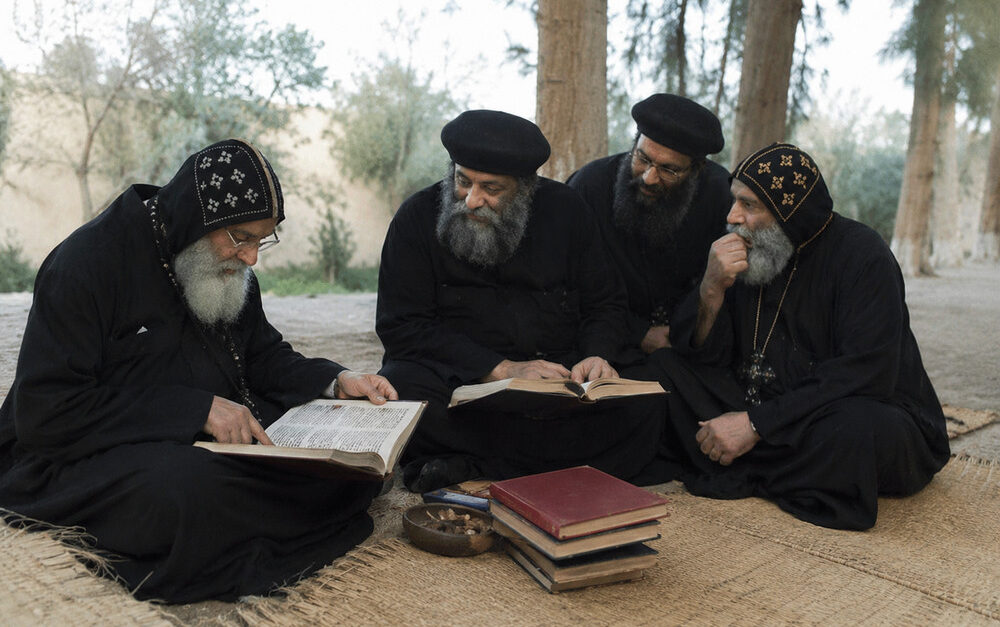
Coptic Cosmogony presents a singular vision among the myths of the origin of the universe by affirming that all creation arises from a free act of a single God, from nothing.
Unlike the pharaonic traditions, there is no emanation nor struggle against chaos here, but rather an intentional and transcendent creation. In Christian Egypt, this shift represents a true spiritual and philosophical transformation.
In this article, we will explore Coptic Cosmogony as a profound reinterpretation of creation, inspired by Genesis and developed through the tradition of the Desert Fathers, where the desert becomes a space of inner renewal and encounter with the divine.

The Coptic context: Christianity in the cradle of the pharaohs
To understand Coptic Cosmogony, it is crucial to situate its emergence as a conscious and deliberate opposition to the religious universe of Ancient Egypt.
- The arrival of Christianity in Egypt: Coptic tradition attributes the evangelization of Egypt to the Evangelist Mark himself in the 1st century AD. Christianity quickly took root, especially among the Coptic-speaking population (derived from ancient Egyptian), becoming the dominant religion until the Arab conquest in the 7th century;
- A radical theological rupture: the first Coptic theologians, such as Saint Athanasius (4th century), in their struggle against Arianism, strongly emphasized the doctrine of creation ex nihilo (from Nothing). This was a direct denial of Egyptian Cosmogony, which always began from a preexisting matter or energy (the waters of Nun, the cosmic egg, the primordial lotus). For the Copts, matter is not eternal; it is a good, but not divine, creation of a God who exists completely beyond it;
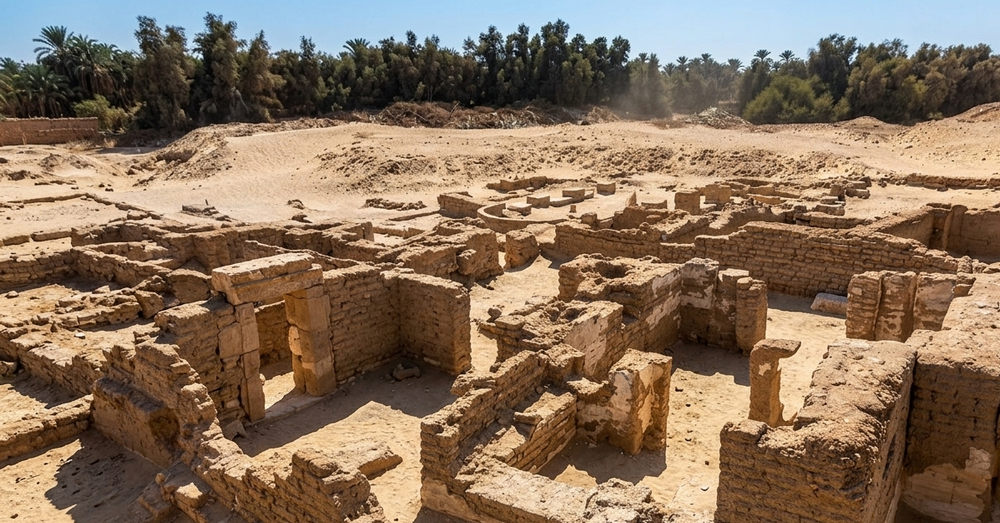
- The Desert Fathers and the spiritual reconquest of space: figures such as Saint Anthony of the Desert (the father of Christian monasticism) and Saint Pachomius deliberately chose the desert — the realm of chaos (Isfet) and demons in the Egyptian worldview — for hermitages and monasteries. This was not an escape from the world, but a spiritual reconquest of the territory of chaos. By overcoming demonic temptations in the desert, they were symbolically repeating God’s creative act, imposing divine order (the Cosmos) upon primordial chaos, now in an inner and spiritual battle.
The narrative of creation: the One and Triune God and the goodness of matter
Coptic Cosmogony is grounded in a specific reading of Genesis, enriched by a robust Christology:
The Creator God: One, Triune, and Transcendent
For the Copts, the creator is not the conflicting pantheon of Egyptian gods, nor the sun god Atum who creates himself. The Creator is the One and Triune God revealed in Scripture: Father, Son (Logos), and Holy Spirit.
- The Father is the ultimate source and origin of the creative will;
- The Son (Jesus Christ, the Logos) is the active agent of creation. Following the prologue of the Gospel of John, the Copts believe that “All things were made through him, and without him nothing was made that has been made” (John 1:3). The Logos who ordered the cosmos in Genesis is the same one who became incarnate in the womb of the Virgin Mary;
- The Holy Spirit is the one who “hovered over the waters” (Genesis 1:2), granting life, order, and completeness to the creative work.
The mechanism of creation: the word and sovereign will
Creation is an act of pure sovereign will and word. “God said, ‘Let there be light’; and there was light” (Genesis 1:3). This mechanism is radically different from the organic and, at times, corporeal processes of Egyptian mythology (masturbation, spit, tears).
Creation through the word emphasizes the absolute transcendence of God: He does not need preexisting matter; His word is effective in itself.
The goodness of creation and the dignity of the body
A direct consequence of the belief in a good God as the sole creator is the fundamental goodness of all material creation. “And God saw everything that He had made, and behold, it was very good” (Genesis 1:31). This represented a liberation from the dualistic view that saw the body and the material world as a prison or an evil illusion (as in some Gnostic currents that also threatened the early Church).
For the Coptic monks in the desert, this belief was practical: asceticism was not a rejection of the body as evil, but a discipline to subdue disordered passions and free the body to become a temple of the Holy Spirit. The body, created by God, is redeemed by Christ and destined for resurrection.
Analysis and meaning: a new cosmic order and the struggle against demons
Coptic Cosmogony was not an abstraction; it completely redefined the Egyptian relationship with the cosmos and the divine.
The desacralization of nature and victory over the “gods”
By affirming that only God is divine and that the world is His creation, the Copts desacralized nature. The Nile River was no longer the god Hapi, the sun was no longer Ra, and the sky was no longer the goddess Nut. They were beautiful works of the one God.
The ancient Egyptian gods were reduced, in the Coptic view, to the status of demons or deceptive idols. Christ’s victory on the Cross was seen as the cosmic defeat of these demonic powers.
Humanity as the image of God, not as servant
Na Cosmogonia Egípcia, a humanidade era cria dos deuses, concebida para servi-los. Na visão copta, o ser humano é criado “à imagem e semelhança de Deus” (Gênesis 1:26). Isso confere uma dignidade e um valor intrínsecos a cada pessoa, independentemente de sua posição social, uma ideia revolucionária no contexto antigo.
Continuous creation and the Jesus Prayer
Coptic spirituality, especially within monasticism, emphasizes the idea of continuous creation.
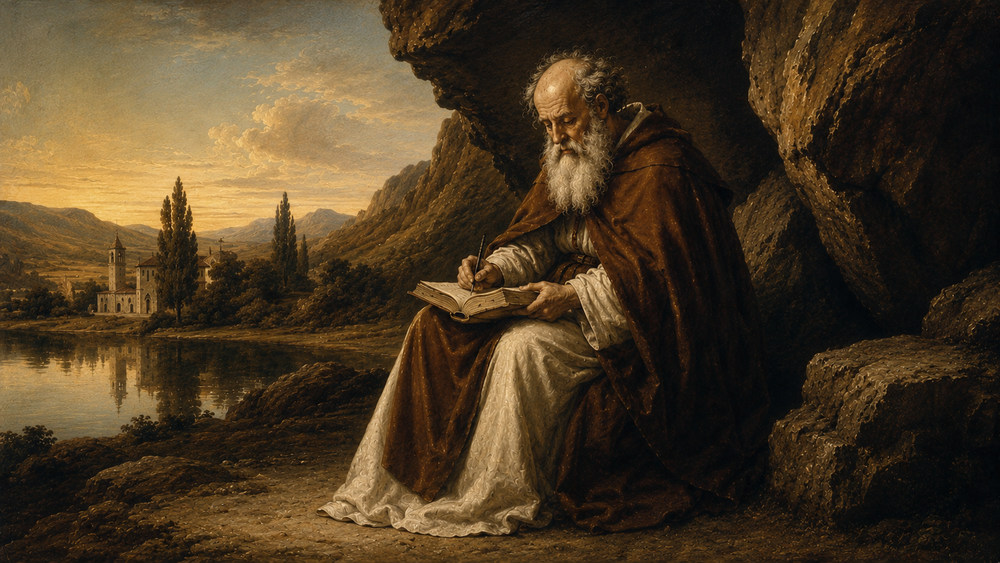
The ceaseless prayer of the heart, particularly the “Jesus Prayer” (“Lord Jesus Christ, Son of God, have mercy on me, a sinner”), is not merely a petition, but an act of participating in the divine energy that sustains the cosmos at every instant. The monk, in his cell, becomes a co-worker with God in the work of maintaining and sanctifying creation.
Contrast with the Cosmogony of Ancient Egypt
- Versus Heliopolis: it replaces the self-generation of Atum with the voluntary creation of the Trinity;
- Versus Hermopolis: it replaces the impersonal forces of the Ogdoad with the personal and relational God;
- Versus Memphis: it appropriates the idea of creation through the word (Ptah), but purifies it of any materialism, making it a purely spiritual act of the Trinity.
Conclusion
Coptic Cosmogony represents a profound and well-established transformation of an entire cosmological system. Where there was once a pantheon of immanent gods, the belief in a single, transcendent, and creator God is affirmed.
Creation ceases to be a process of emanation and becomes an absolute act, carried out from nothing through the divine word. The desert, once associated with chaos, becomes a space of spiritual discipline and inner victory, marking a new relationship between the human being, the divine, and the cosmos.
To expand this reflection on how different cultures explain the origin of the universe, I also suggest exploring Hindu Cosmogony, cosmogonic patterns in North America, and Australian Aboriginal Cosmogony, each offering unique perspectives on creation.
May the Light of Love be the guide of all paths, at all times, in all circumstances, with all the people. And may Love foster Peace!
Bibliographical references
1. ATHANASIUS OF ALEXANDRIA. On the Incarnation of the Word.
A foundational text of Coptic theology, in which Athanasius articulates the relationship between creation, the fall, and redemption, defending the divinity of the creative Logos against heresies.
2. MEINARDUS, Otto F. A. Two Thousand Years of Coptic Christianity. The American University in Cairo Press, 2002.
A comprehensive reference work tracing the history, theology, and practices of the Coptic Church, providing the essential context for understanding its unique development.
3. WORRELL, William H. (Trans.). The Coptic Manuscripts in the Freer Collection. The Macmillan Company, 1923. (Includes texts such as The Life of Saint Anthony by Athanasius).
Access to primary sources, such as The Life of Saint Anthony, is crucial for understanding the spirituality and worldview of the first Coptic monks and their struggle in the desert.
4. CHITTY, Derwas J. The Desert a City: An Introduction to the Study of Egyptian and Palestinian Monasticism Under the Christian Empire. St. Vladimir’s Seminary Press, 1995.
A classic study of the monastic movement that emerged in Egypt, explaining how the Coptic worldview was expressed in the practical and ascetic life of the Desert Fathers.