


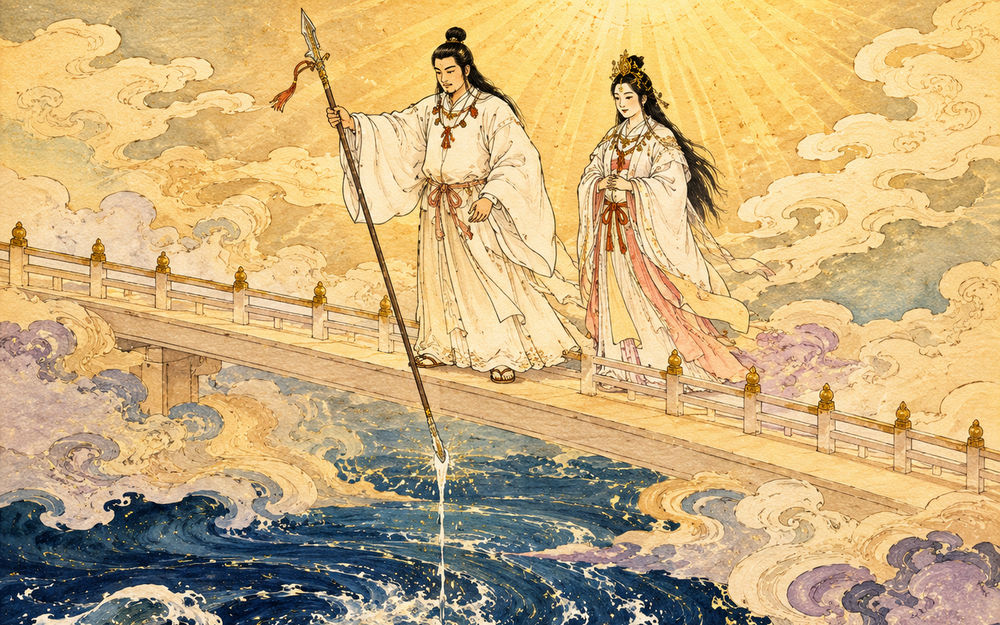
Shinto Cosmogony presents one of the most striking narratives among myths about the origin of the universe, describing creation as a generational process carried out by deities who shape not only the land but also the forces that govern life, death, and nature.
For those seeking to understand what Cosmogony is, Shintoism offers a fascinating example of how a tradition can unite the origin of the world, the identity of a people, and the sacred character of the landscape within a single narrative.
In this article, I will explore the accounts preserved in the Kojiki and the Nihon Shoki, following the journey of Izanagi and Izanami from the formation of the Japanese islands to the events that established the foundations of ritual purity and the relationship between human beings and the Kami. It is a story in which geography, spirituality, and ancestry are inseparably intertwined.

The Shinto context: Kami, purity, and national identity
To understand Shinto Cosmogony, it is essential to grasp its central concepts and its role in shaping Japanese cultural identity:
- Kami, the nature of the divine: Shintoism is both polytheistic and animistic. The term Kami does not refer merely to "gods" in the Western sense, but to a vast range of spirits, forces, or sacred essences that inhabit all things. Mountains, rivers, trees, natural phenomena, prominent ancestors, and even concepts can be Kami. They are neither omnipotent nor transcendent; they are intimately involved with the world and can be benevolent or dangerous.
- The importance of purity and purification: A fundamental concept in Shintoism is purity. Impurity (Kegare), which may be caused by death, illness, blood, or transgressions, is seen as a state of separation from the Kami and a source of misfortune. Purification rituals (Harae) are therefore central to Shinto practice, aiming to restore a state of original purity and harmony.
- Cosmogony as imperial legitimization: The texts of the Kojiki and the Nihon Shoki were compiled under the patronage of the imperial court to legitimize the emperor’s lineage by tracing his ancestry directly to the sun goddess, Amaterasu Omikami. The cosmogonic narrative is therefore not merely a myth but the cornerstone of Japanese national identity and the imperial institution.
The creation narrative: the procreation of the world and the descent into shadow
Shinto Cosmogony can be divided into three main acts: primordial creation, the generation of the islands and the Kami, and the drama that leads to the birth of the most important deities.
The primordial state: undifferentiated chaos
In the beginning, the universe was an undifferentiated and chaotic mass, without form, resembling floating oil. The first Kami emerged spontaneously and, after several generations, gave rise to Izanagi-no-Mikoto (He Who Invites) and Izanami-no-Mikoto (She Who Invites), the two primordial creator deities.
The creation of the islands and the procreation of the Kami
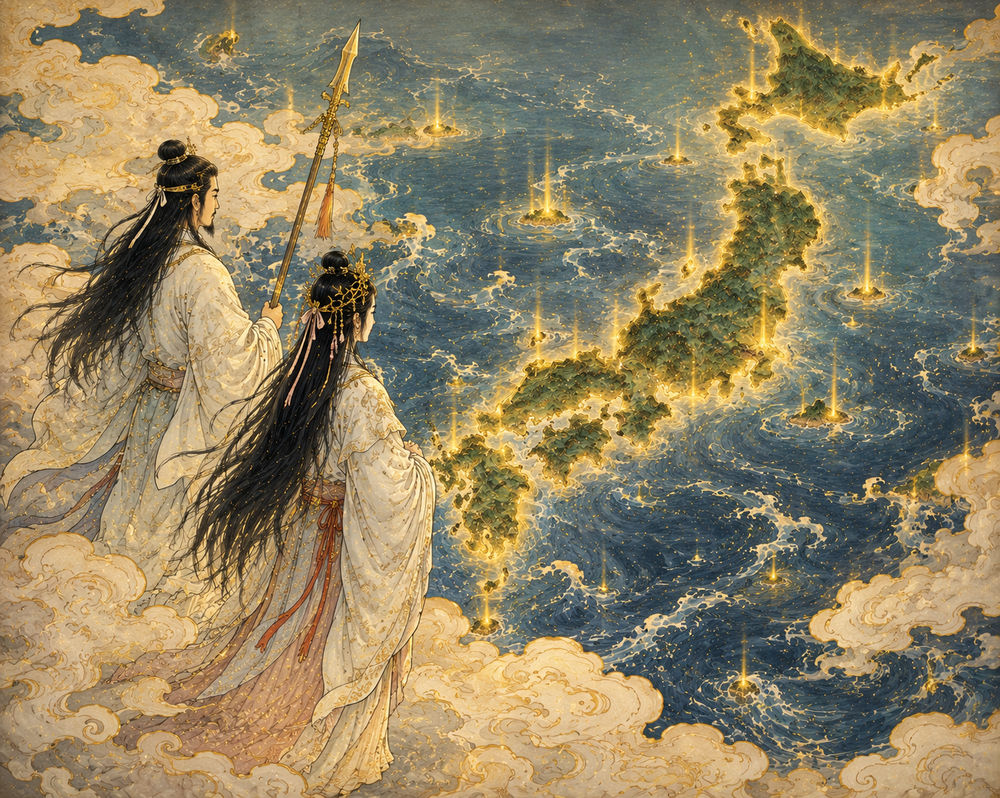
Izanagi and Izanami were placed upon the Floating Bridge of Heaven (Ame-no-ukihashi) and tasked with giving form to the earth, which was still fluid. They dipped a heavenly spear (Ame-no-nuhoko) into the primordial waters below. When they withdrew it, the drops of salt that fell from the tip of the spear coagulated and formed the first island, Onogoro-shima (“Self-Coagulating Island”).
They descended to this island and erected a heavenly pillar and a palace. They began a mating ritual, circling the pillar in opposite directions. When they met, Izanami, the female, spoke first: “What a delight, I have met a handsome young man.” They united, but the child born from this union was Hiruko (the leech child), deformed and unable to stand. They placed the child in a reed boat and set it adrift.
The elder Kami intervened, explaining that the error lay in the protocol: in such a union, the man must speak first. They repeated the ritual, and this time, when they met, Izanagi, the male, spoke first: “What a delight, I have met a beautiful maiden.” From this proper union, the Eight Great Islands of Japan were successfully born (Awaji, Shikoku, Oki, Kyushu, Iki, Tsushima, Sado, and Honshu).
They continued procreating, generating a multitude of Kami who personified the elements of nature: the wind, mountains, rivers, trees, and plains.
The death of Izanami and the origin of death
While giving birth to the fire Kami, Kagutsuchi, Izanami suffered severe burns to her genitals and died. Enraged and grief-stricken, Izanagi killed Kagutsuchi with his sword, and from the blood and body of the fire god, more Kami were born.
Overcome with sorrow, Izanagi descended into Yomi-no-Kuni (the Land of Shadows, the realm of the dead) to bring Izanami back. She agreed to negotiate with the Kami of Yomi-no-Kuni but made Izanagi promise not to look at her. Impatient, he broke his promise and, lighting one of the teeth of his comb as a torch, illuminated his wife. Horrified, he saw her decomposing body, infested with worms.
Ashamed and enraged at having been seen in her impure state, Izanami pursued Izanagi, who fled from Yomi-no-Kuni and sealed its entrance with a massive boulder. Forever separated, Izanami declared that she would kill a thousand inhabitants of the world every day in revenge. Izanagi responded that he would then ensure the birth of fifteen hundred people each day, thus establishing the cycle of life and death.
The birth of the three noble deities and purification
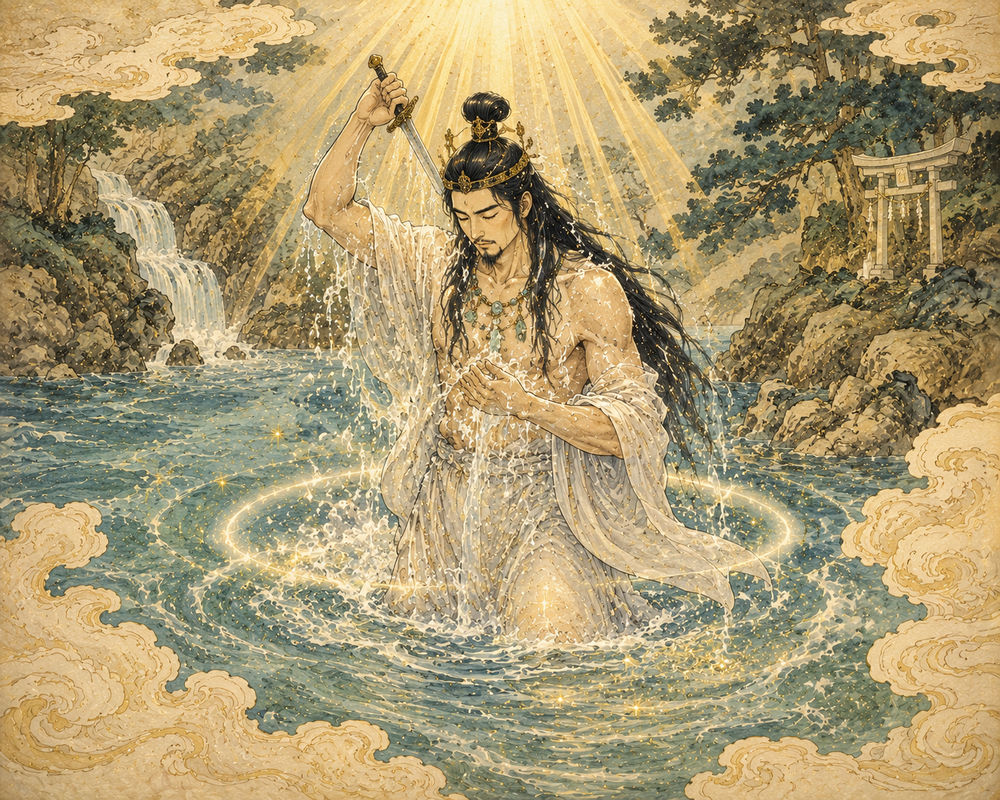
Upon returning from the impure realm of Yomi-no-Kuni, Izanagi performed a purification ritual (Misogi) in a river. As he washed himself, some of the most important Kami of the Shinto pantheon were born from his clothing and body:
- While washing his left eye, Amaterasu Omikami, the sun goddess who illuminated the world, was born.
- While washing his right eye, Tsukuyomi-no-Mikoto, the moon god, was born.
- While washing his nose, Susanoo-no-Mikoto, the god of storms and the sea, was born.
If you’re enjoying exploring different narratives about the origin of the world, take the opportunity to also read about Norse Cosmogony, Australian Aboriginal Cosmogony, and Cosmogonic Patterns of North America, which offer quite different perspectives on the subject.
Analysis and meaning: purity, procreation, and the sacredness of the nation
Shinto Cosmogony encodes the central values and concerns of Japanese culture:
- Creation as procreation and the importance of protocol: Unlike other traditions, creation is not an act of speech, will, or sacrifice, but of literal procreation. This reflects a vision of the world as a vast divine and interconnected family. The incident involving Izanami speaking first emphasizes the crucial importance of proper protocol (hatsuhi) in ensuring order and success in any endeavor, a value that permeates Japanese society.
- The origin of death and the separation of worlds: The drama of Izanagi and Izanami establishes a radical separation between the world of the living and the world of the dead (Yomi-no-Kuni). Yomi-no-Kuni is not a place of judgment or reward but a realm of impurity and decay. This separation underpins the Shinto emphasis on purifying the living after contact with death.
- Sacred geography: The cosmogony is not universal; it is intrinsically national. It explains the specific origin of the islands of Japan, which are therefore a unique and sacred divine creation. The Japanese landscape is itself the body of the Kami.
- The imperial lineage: The birth of Amaterasu from Izanagi’s eye places her in a position of preeminence. She becomes the ancestor of the imperial line, legitimizing the emperor’s rule as a direct descendant of the creator Kami. Thus, the cosmogony serves a clear political and national purpose.
- Contrast with Chinese Cosmogony: Whereas Chinese Cosmogony is abstract and philosophical (Tao, Yin-Yang), Shinto Cosmogony is concrete, narrative, and nationalistic. One focuses on the impersonal principles of the universe; the other on the personal and physical generation of the Japanese nation and its gods.
Conclusion
Shinto Cosmogony presents a universe born from the actions of creator deities, where life, death, nature, and social order are deeply intertwined. It is a narrative that transforms the landscape itself into an expression of the sacred, attributing a living spiritual presence to mountains, rivers, forests, and islands.
Creation is not viewed merely as an event of the distant past but as a reality continuously sustained through the harmonious relationship between human beings, the Kami, and purification rituals.
This perspective highlights the importance of reverence for nature, the preservation of order, and the care of spiritual purity as central elements of existence.
To broaden your study of how different cultures explain the origin of the universe, it is also worthwhile to explore Aztec Cosmogony, which presents a markedly different interpretation centered on cosmic cycles, sacrifice, and the constant renewal of the world.
May the Light of Love be the guide of all paths, at all times, in all circumstances, with all the people. And may Love foster Peace!
Bibliographical references
1. CHAMBERLAIN, Basil Hall (Trad.). The Kojiki: Records of Ancient Matters. Tuttle Publishing, 1982.
The first English translation remains a crucial reference version of Japan’s foundational text, containing the complete cosmogonic narrative of Izanagi and Izanami.
2. PHILLIPI, Donald L. (Trad.). Kojiki. Princeton University Press, 1969.
Another highly respected academic translation, with notes and commentary that help interpret the complex symbolism of the text.
3. BOCK, Felicia G. (Trad.). Engi-Shiki: Procedures of the Engi Era. Sophia University, 1970.
A regulatory text detailing Shinto rituals and practices, providing the context necessary to understand the importance of purity (Kegare) established in the cosmogonic myth.
4. NELSON, John K.A Year in the Life of a Shinto Shrine. University of Washington Press, 1996.
An ethnographic study showing how cosmogonic concepts and the relationship with the Kami manifest in contemporary Shinto ritual practice, connecting myth to modern lived experience.