


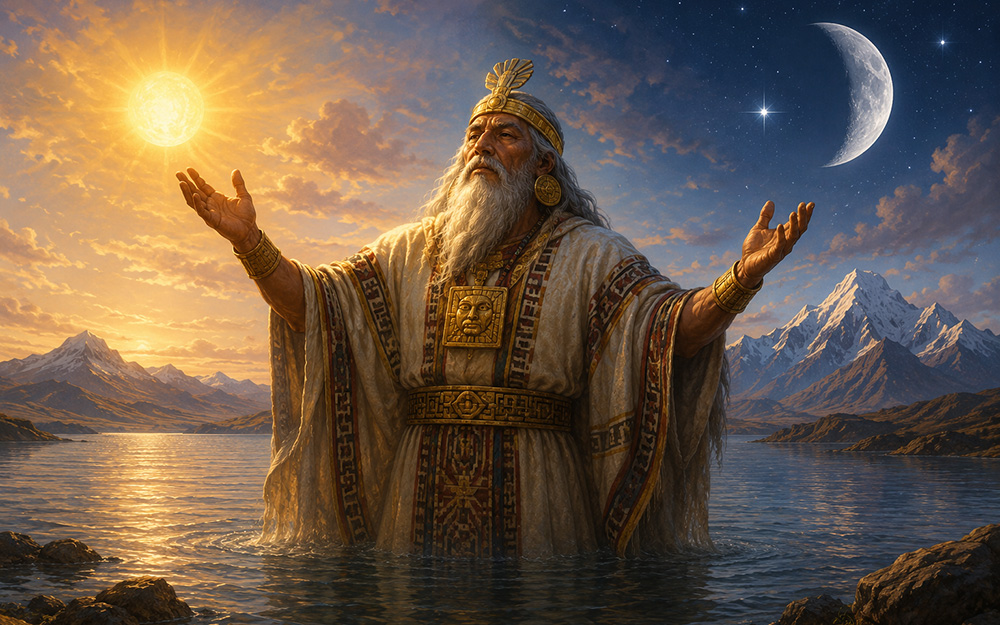
The human journey to decipher the origins of the universe unfolds through two great narratives: Cosmogony, which, through myths and symbols, explores the deeper meaning of existence, and Cosmogenesis, which, through observation and reason, investigates the physical processes of the universe.
In this article, we will explore Inca Cosmogony, a worldview that combines a primordial creation myth with a deeply political narrative of dynastic foundation. Here, creation is not merely an event of the past, but an ongoing project of ordering chaos, carried out by a supreme creator god, Viracocha, and overseen on Earth by the Sapa Inca, the Son of the Sun.
Prepare to understand a worldview in which myth, sacred geography, and the state merge into a single structure of power and meaning.

The Inca Context: State, Order, and Sacred Geography
To understand Inca Cosmogony, it is essential to appreciate the highly organized and expansionist nature of their empire:
- Tawantinsuyu: The Empire of the Four Parts: the Inca Empire was divided into four regions (suyus), which converged at the capital, Cusco (the “Navel of the World”). This fourfold division (Tawantinsuyu) reflected cosmic order and was a central organizing principle of the entire society.
- The Sapa Inca (The Son of the Sun): the emperor, the Sapa Inca, was considered a divine being, the literal son of the Sun God Inti. His absolute authority was therefore of divine origin. The prosperity of the empire depended on his health and his proper mediation with the deities. The royal lineage (panaca) was sacred.
- Official Religion and the Worship of Huacas: the state religion centered on the worship of Inti, but it was incredibly inclusive and pragmatic. The Incas incorporated the gods of conquered peoples into their pantheon, provided that they accepted the supremacy of Inti. In addition, the entire territory was permeated by huacas — mountains, springs, rocks, or temples considered sacred and endowed with power — which formed a complex network of spiritual energy (camay) that required constant ritual maintenance.
Creation Narratives: Viracocha and the Myths of Origin
There are two main creation narratives, one more philosophical and universal (that of Viracocha) and another more political and dynastic (that of Inti and the Ayar brothers).
The Creation by Viracocha, the Supreme God
In the beginning, there was only Viracocha, the creator god, omnipotent and omnipresent, who dwelled in the primordial waters or the cosmic void. After a great flood that destroyed the first humanity, Viracocha emerged from Lake Titicaca (or from the Cave of Pacaritambo, depending on the version).
- The Creation of Light and Order: his first action was to bring light into the world, creating the sun, the moon, and the stars.
- The Creation of the Earth and Humanity: he shaped the Andean landscape, sculpting mountains and opening valleys. Then, using stones (pacarinas), he carved new human beings, giving them life and instilling in them culture, language, customs, and laws.
- The Civilizing Mission: Viracocha did not create the world merely to remain in it. He sent his “children” or divine emissaries (generally in pairs) in different directions to civilize humanity. He himself traveled the world disguised as a beggar, teaching and testing people before disappearing into the Pacific Ocean, with the promise that he would one day return.
The Dynastic Origin Myth: The Ayar Brothers and the Foundation of Cusco
This myth, collected by chroniclers of Inca culture, explains the origin of the imperial lineage and the founding of the capital:
- The Emergence from the Window: from the three windows of the Cave of Pacaritambo (“The House of Dawn”), four brothers (Ayar Manco, Ayar Cachi, Ayar Uchu, and Ayar Auca) and their four sister-wives emerged. They were the founders of the Inca nation.
- The Journey and the Elimination of Rivals: during the journey to find an ideal place to settle, the stronger or more troublesome brothers were gradually neutralized. Ayar Cachi, of extraordinary power, was deceived and walled up inside a cave. Ayar Uchu was turned to stone and transformed into a huaca. Ayar Auca turned to stone at another location.
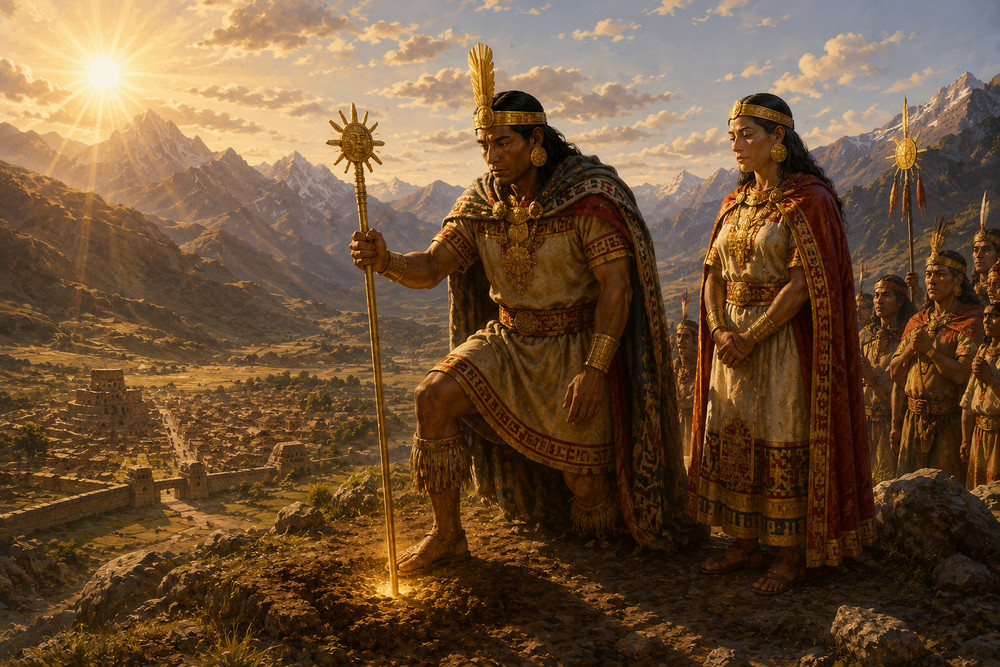
- The Foundation of Cusco: only Ayar Manco remained, carrying a golden staff. He reached the valley of Cusco and, when he saw the staff sink completely into the fertile earth, he founded the sacred city. He changed his name to Manco Cápac, the first Sapa Inca, while his sister-wife, Mama Ocllo, became the first Coya (Empress). They taught the local peoples agriculture, weaving, and laws, establishing Inca civilization.
The Connection with the Sun God: In the official state version, Manco Cápac and Mama Ocllo were children of the Sun God Inti himself, sent to Earth to bring order and civilization. This founding myth divinely legitimized the ruling dynasty and its imperial mission of conquest and organization.
Analysis and Meaning: a Cosmos Mirrored in the State
Inca Cosmogony reveals a worldview in which religion, state, and geography are inseparable.
Duality and Reciprocity (Ayni)
The principle of complementary duality (yanantin) was fundamental: sun/moon, man/woman, high/low. This duality was reproduced in the structure of the state (Sapa Inca / Coya, Hanan Cusco / Hurin Cusco). The relationship between the people and the state was governed by ayni, a sacred reciprocity: the people provided labor (mit’a) and tribute, while the state, in return, provided security, organization, and ritually obligatory festivals.
Order as a Cosmic Objective
Chaos was the antithesis of Inca order. The creation by Viracocha and the mission of Manco Cápac had as their primary objective the imposition of order (Tawantinsuyu) upon chaos. Military expansion, the construction of roads, agricultural terraces, and the food storage system were all expressions of this cosmic imperative to bring order to the world.
The Sacralization of the Territory
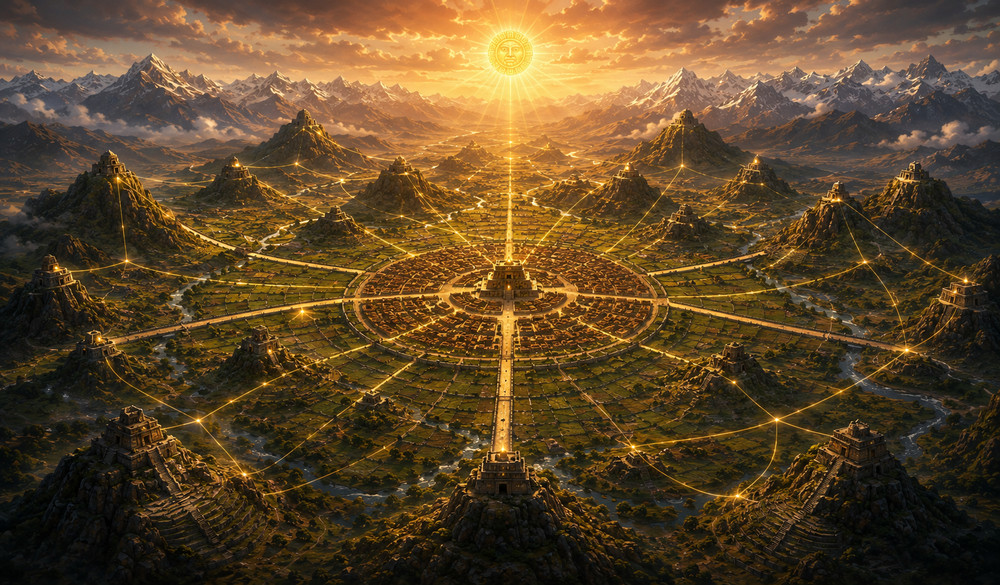
The empire was not a geographical accident; it was a sacred entity. The network of huacas and the ceques (imaginary lines extending from Cusco and connecting the huacas) formed an enormous ritual calendar and map that organized space and time, integrating the entire conquered territory into the sacred cosmos centered on Cusco.
Contrast with Tupi-Guarani Cosmogony
While the Tupi-Guarani sought to escape the imperfect world through migration, the Incas sought to transform the world in their own image and likeness, imposing upon it the perfect order of their cosmic and social model. One worldview is centrifugal (seeking to leave), while the other is centripetal (seeking to integrate and dominate).
Conclusion
Inca Cosmogony reveals how different peoples sought to understand the origin of the universe and the role of human beings within the cosmic order. By learning about this tradition, it becomes possible to recognize both its unique characteristics and its points of connection with other ancestral narratives.
If you wish to broaden this perspective, it is also worth exploring Australian Aboriginal Cosmogony, marked by the Dreamtime and the profound connection between ancestors and the landscape, as well as Maori Cosmogony, whose creation of the world is intimately connected to the forces of nature, the gods, and the relationship between heaven and earth. Each of these traditions offers a unique perspective on the great mysteries of existence.
May the Light of Love be the guide of all paths, at all times, in all circumstances, with all the people. And may Love foster Peace!
Bibliographical references
1. GARCILASO DE LA VEJA. Inca. Comentarios Reales de los Incas. (1609).
The most famous primary source, written by a descendant of Incas and Spaniards. It offers the “official” and dynastic version of the origin myths, but should be read with attention to its pro-Inca bias.
2. SULLIVAN, William. The Secret of the Incas: Myth, Astronomy, and the War Against Time. Crown, 1996.
An innovative study that explores the connections between Inca cosmology, astronomy, and their understanding of time, interpreting the myths in light of astronomical knowledge.
3. URTON, Gary. Inca Myths. University of Texas Press, 1999.
A concise and accessible presentation of the main Inca myths, including the narratives of Viracocha and the Ayar brothers, with excellent contextualization.
4. D’ALTROY, Terence N. The Incas. Blackwell Publishing, 2002.
A comprehensive and up-to-date academic work on the Inca Empire, providing the essential historical, political, and social background for understanding the role of cosmogony within the state structure.