


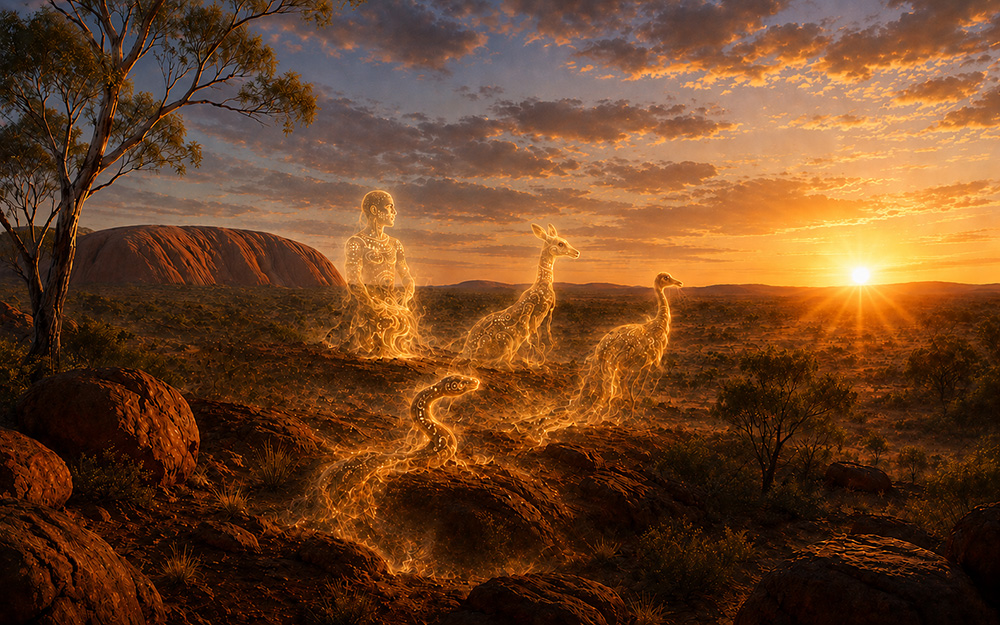
Australian Aboriginal Cosmogony preserves one of the oldest traditions among the myths about the origin of the universe, presenting a worldview in which creation remains alive and present in nature.
For Aboriginal peoples, the Dreamtime or Dreaming is the ancestral era in which spiritual beings shaped the landscape, gave rise to life, and established the Sacred Laws that continue to guide the world. This narrative reveals a profound connection between the land, the ancestors, and collective memory.
In this article, you will learn about the main elements of this tradition, marked by the Creator Ancestors, sacred songs, and totemic beings that sustain reality.

The Aboriginal Context: “Dreaming,” Land, and Law
To understand Australian Aboriginal Cosmogony, it is essential to appreciate concepts that challenge Western categories of time and history.
The “Dreamtime” (Dreaming)
This translation is inadequate, although it has become established, for a complex concept found in Aboriginal languages, such as Alcheringa among the Arrernte or Jukurrpa among the Warlpiri.
The Dreaming is neither a “dream” in the sense of fantasy nor a linear “time” in the past. It is a parallel and eternal temporal reality, the time of creation that continues to exist and influence the present. It is the source of all life, meaning, and law.
The Inseparability of People and Land (Country)
For Aboriginal peoples, individual and group identity is inextricably linked to their Country, a specific area of land with its rivers, mountains, and plants. They do not own the land; they belong to it.
The land is the physical and living record of the deeds of the Ancestors of the Dreaming. Every geographical feature is evidence of and a reminder of a creative event.
Oral Transmission and Rock Art
Cosmogonic knowledge was not written down, but preserved and transmitted through generations by means of complex oral narratives, ceremonies, dances, ritual performances (“corroborees”), songs, and a rich tradition of rock and body art. These were not mere forms of entertainment; they were acts of maintaining creation.
The Creation Narrative: The Journey of the Ancestors and the Song of the World
There is no single creation narrative, but hundreds, associated with different language groups and their Countries. Nevertheless, a common pattern emerges:
The Primordial State: The Flat and Sleeping World
In the beginning, the Earth was a vast, dark, featureless plain. There were no hills, rivers, or life as we know it. It was a place of pure potentiality, asleep. Beneath the surface, however, rested the Ancestors of the Dreaming, spiritual beings in the form of animals, humans, or plants.
The Awakening and Emergence
At a certain moment, these Ancestors awakened from their sleep and began to emerge from the earth, the sky, or the sea. Their actions, simply by existing and moving, began to shape the world.
The Creation Journeys (“Footprints of the Ancestors”)
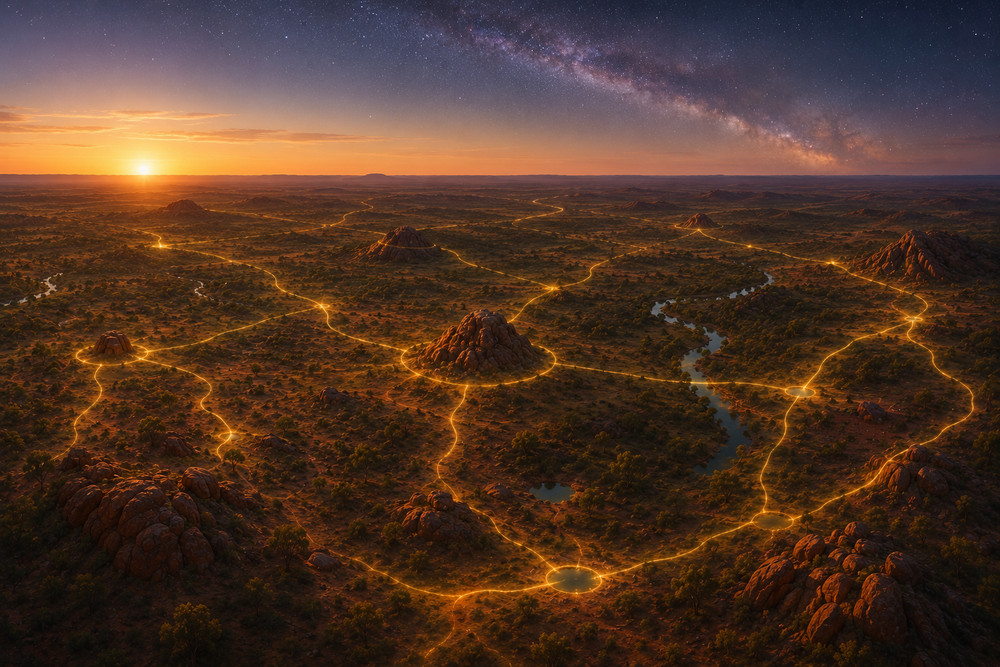
The Ancestors embarked on long journeys across the landscape. As they walked, they sang, danced, fought, loved, and performed rituals. Each of their actions imbued the virgin land with meaning, creating its features:
- Where an Ancestor sat, a mountain was formed.
- Where an Ancestor threw a spear, a river was opened.
- Where an Ancestor’s blood was spilled, trees with red leaves sprang forth.
- Where an Ancestor left behind a ritual object, a mineral deposit was formed.
These journey routes are the “footprints of the Ancestors.” At the same time, they are physical navigation trails, trade routes, and sequences of sacred songs that, when recited or sung, reactualize the creative act and keep the world alive.
The Transformed Ancestors
At the end of their journeys, many Ancestors, weary from their works, “returned to the Dreaming.” They were transformed into features of the landscape, such as a rock or a pool of water, into celestial bodies, or simply returned to the interior of the earth. However, they left behind their spiritual essence and the Laws of the Dreaming.
The Creation of Human Life
In some myths, the Ancestors shaped the first human beings from clay or from the earth itself. In others, they created them during their journeys. In many narratives, humans were already present in a latent form and were “awakened” or transformed by the Ancestors.
What is crucial is that each group of people descends from a specific Ancestor, their totem, creating an eternal spiritual bond with that being and with everyone else who shares the same totem.
An Emblematic Example: The Rainbow Serpent
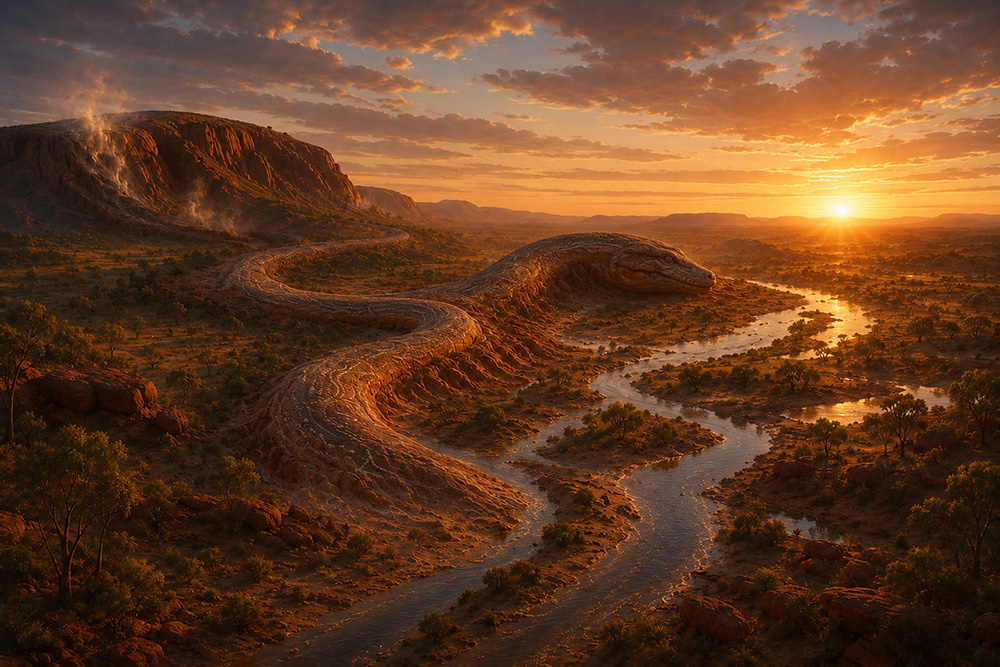
One of the best-known Creator Ancestors is the Rainbow Serpent. In many cultures of northern Australia, she is a colossal and powerful being associated with water, fertility, and creation. As she emerged from her sleep beneath the earth, her heavy body carved out riverbeds, while her movements formed mountains and valleys. She is responsible for the creation of many forms of life and the guardian of the Sacred Laws.
If you would like to broaden your understanding of different ways of explaining the creation of the world, it is also worth learning about Maori Cosmogony, another rich ancestral tradition that presents its own interpretation of the origin of the universe.
Analysis and Meaning: a Living Cosmos and Human Responsibility
Australian Aboriginal Cosmogony reveals a holistic, ethical, and profoundly ecological worldview.
Creation as an Ongoing Process
The world was not created and then abandoned. The creative energy of the Dreaming still flows. Rituals, songs, and paintings are not representations; they are acts of co-creation. When a group sings the song of its Ancestor along a creation journey, they are literally recreating the world, revitalizing the land, and ensuring the continuity of life.
The Law of the Dreaming (The Law)
The deeds of the Ancestors established an eternal and immutable code of conduct known as “The Law.” This law dictates the proper relationships between people, between clans, and between humanity and nature. Transgressing this law is not merely a social crime; it is a cosmological act that can break the connection with the Dreaming and bring chaos.
Deep Ecology
The Aboriginal worldview is perhaps the most radically ecological one that exists. The land is not a resource to be exploited, but a living relative to be cared for. “Country management” or “land management,” such as controlled burning to renew vegetation, is a religious duty, a way of maintaining creation as the Ancestors understood it.
Contrast with Other Cosmogonies
- Compared with Abrahamic traditions (such as Islamic Cosmogony and Hindu Cosmogony: It replaces transcendent gods or abstract cosmic cycles with an immanent creation embodied in the landscape itself.
- Compared with Aztec and Inca traditions: It contrasts with state-centered and hierarchical cosmogonies. Here, creative power is distributed throughout the land, and authority is custodial rather than imperial.
Conclusion
Australian Aboriginal Cosmogony presents us with a universe that is a living web of sung stories, an ancestral map that remains constantly present. Creation is not an event confined to the past, but a force that continues to manifest through the Dreaming, present in every rock, stream, and living creature.
This worldview places a profound responsibility upon humanity: to preserve the memory of the Ancestors, honor the Sacred Laws, and keep alive the connection between the land, nature, and future generations.
If you are interested in the different ways ancient peoples explained the origin of existence, continue exploring the other traditions featured in our series on cosmogonies!
Babylonian Cosmogony reveals a universe shaped by conflicts among primordial deities, while Norse Cosmogony presents the creation of the world through the encounter between ice and fire, in a narrative filled with giants, gods, and symbolism. Each of these traditions expands our understanding of the diverse paths humanity has taken to interpret the mysteries of creation.
See you soon!
May the Light of Love be the guide of all paths, at all times, in all circumstances, with all the people. And may Love foster Peace!
Bibliographical references
1. CHATWIN, Bruce. The Songlines. Penguin Books, 1987.
A classic literary work that, although not a rigorous academic study, powerfully and poetically captures the concept of Songlines and their centrality to Aboriginal culture.
2. STANNER, W. E. H. The Dreaming & Other Essays. Black Inc. Agenda, 2009.
A collection of essays by one of the most respected anthropologists to study Aboriginal peoples, including his seminal “The Dreaming,” which defines and explores this fundamental concept.
3. NEALE, Margo (Ed.). Songlines: The Power and Promise. Thames & Hudson, 2021.
A contemporary and comprehensive work, often featuring Aboriginal voices directly, which explores Songlines from the perspectives of history, art, science, and activism.
4. MYERS, Fred R. Pintupi Country, Pintupi Self: Sentiment, Place, and Politics among Western Desert Aborigines. University of California Press, 1991.
An in-depth ethnographic study illustrating how the cosmology of the Dreaming is lived and experienced in everyday life by a specific group from the Western Desert.