


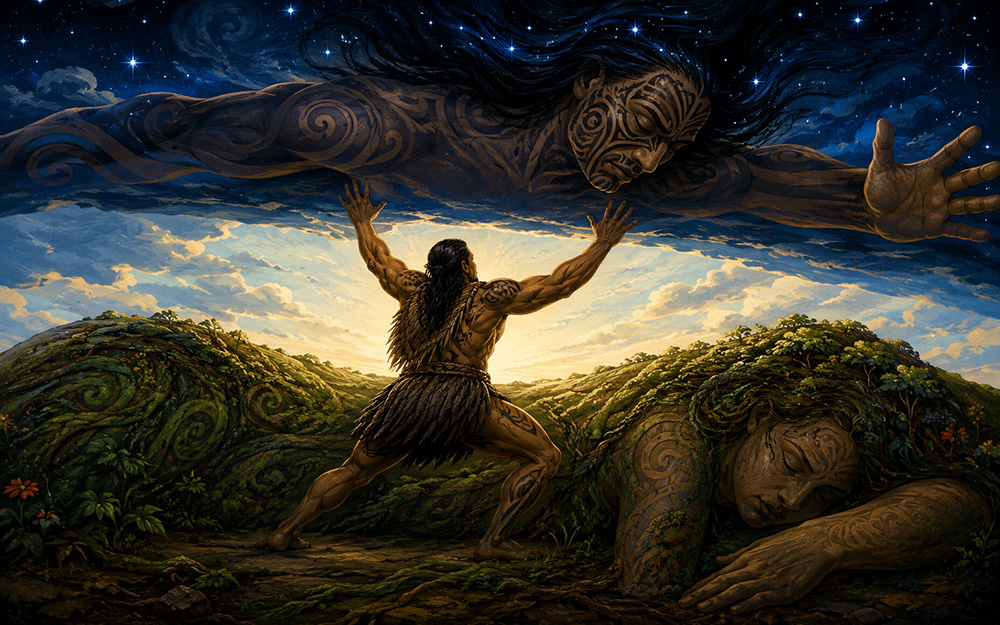
Maori Cosmogony presents a vision of the universe marked by kinship, ancestry, and the profound connection between all beings. In Aotearoa, the Land of the Long White Cloud, the creation of the world is linked to the separation of Ranginui, the Sky Father, and Papatūānuku, the Earth Mother, whose embrace kept their children in darkness.
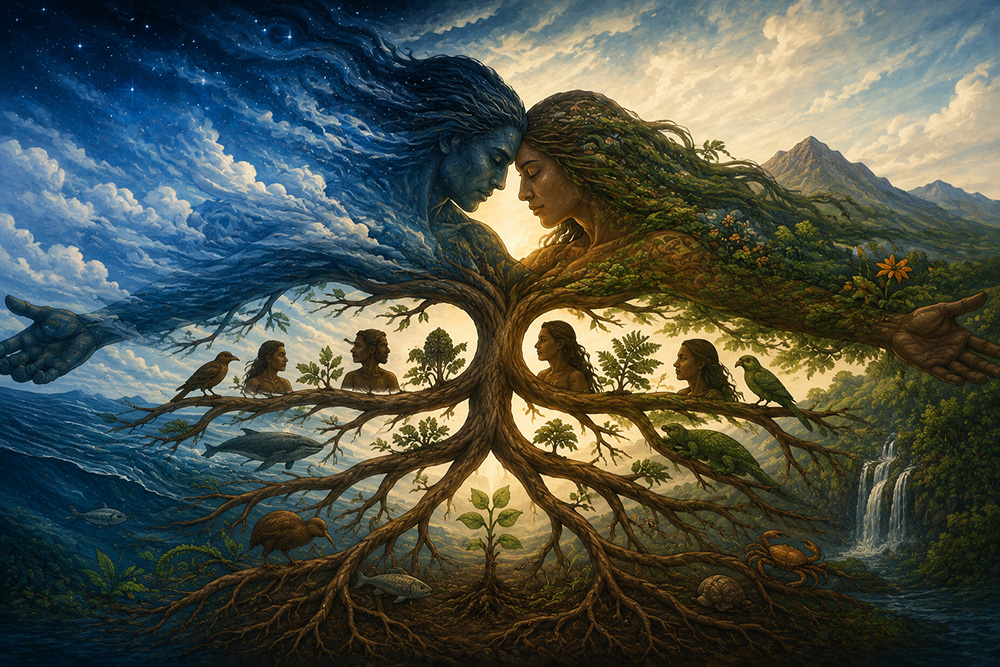
For light to reach the world, their descendants had to break this union, giving rise to a new cosmic order. This narrative also reveals the principle of Whakapapa, the genealogy that establishes the bonds between gods, humans, animals, plants, and other elements of existence.
Thus, Maori Cosmogony brings together a complex narrative about the origin, kinship, and organization of the universe. It features figures such as Tāne Mahuta, associated with forests, and Tāwhirimātea, associated with winds and storms, along with other descendants of Rangi and Papa.
The separation of the Sky Father and Earth Mother represents not only the emergence of light and space, but also establishes a structure of relationships that connects different forms of life.
The concept of Whakapapa expresses precisely this understanding that every being has a place within a great cosmic lineage.

The Maori Context: Whakapapa, Mana, and the Arrival in Aotearoa
To understand Maori Cosmogony, it is essential to understand the pillars of their culture, which are deeply connected to the land and ancestors:
Whakapapa – The Backbone of Reality
Whakapapa is much more than a genealogy; it is a cosmological principle. It is the lineage that connects all things, from the primordial gods to a specific fern in the forest, encompassing every human being. To know one's own Whakapapa is to understand one's place in the universe and one's kinship with everything that exists. The creation narrative itself is a recitation of Whakapapa.
Mana and Tapu – Power and Restriction
Mana is the spiritual life force, prestige, and effective power that flows through Whakapapa. It can be inherited or earned. Tapu is the state of sacred restriction that protects Mana. Violating Tapu through an inappropriate act can bring imbalance and misfortune. The creation of the world was a process of establishing and distributing Mana and Tapu.
The Arrival in Aotearoa
Maori Cosmogony is intrinsically connected to their history of migration. Around the 13th century, large ocean-going canoes (waka) departed from Hawaiki, the Polynesian spiritual homeland, and arrived in Aotearoa. The creation narratives provided a divine foundation for the settlement and kaitiakitanga, or guardianship, of this new land by these descendants of the gods.
The Creation Narrative: From the Void to the Drama of Separation
Maori Cosmogony is a sequence of stages of emergence, from the most subtle to the most concrete, culminating in a fundamental dramatic event.
Te Kore: The Potential Void and the Emergence of Consciousness
Creation begins not with matter, but with potentiality. A sequence of stages of Te Kore, the Void or Darkness, unfolds: Te Kore-tua-tahi (The First Void), Te Kore-tua-rua (The Second Void), and so on. From this potential void emerges the first spark of consciousness, the desire to exist. From this desire arise Ranginui (the Sky, the Masculine) and Papatūānuku (the Earth, the Feminine).
The Primordial Embrace and the Suffering of the Children
Rangi and Papa emerged intertwined in a loving and close embrace. Between them, in the damp and suffocating darkness, more than 70 divine children were born. These children were the gods who personified the forces of nature, such as:
- Tāne Mahuta: god of forests, birds, and insects.
- Tāwhirimātea: god of winds and storms.
- Tangaroa: god of the oceans and all aquatic beings.
- Rongo-mā-Tāne: god of agriculture and cultivated plants.
- Haumia-tiketike: god of uncultivated wild foods.
- Tūmatauenga: god of war, conflict, and humanity.
These gods lived in perpetual darkness, lamenting their condition. They longed for space, light, and the power to manifest their own natures.
The Great Debate and the Act of Separation
The children debated what to do. Some, such as Tūmatauenga (War), advocated killing their parents. Others feared such a radical solution. It was Tāne Mahuta (the Forest) who proposed the solution: separating them, pushing Rangi upward and fixing Papa below.
One by one, the gods tried and failed. Rongo (Peace) could not do it. Haumia (Wild Plants) could not do it. Tangaroa (the Ocean) could not do it. Tūmatauenga (War) could not do it. Then Tāne Mahuta positioned himself upside down against his mother and, with his powerful legs, representing the mountains and pillars of the forest, began pushing with colossal strength. With a cry of pain and anguish, Rangi and Papa were separated. Light (Te Ao Mārama) flooded the space between them for the first time.
The Consequences: Conflict and Order
The separation, although necessary, was an act of cosmic violence that unleashed consequences:
- The Fury of Tāwhirimātea: the god of winds, who had opposed the separation, became furious. He followed his father into the heavens and unleashed terrible storms and cyclones upon his brothers, forcing Tangaroa to retreat into the ocean and Haumia to hide within the earth.
- The Order of the World: despite the conflict, a new order emerged. With space and light, the gods were able to populate their domains. Tāne created the forests and, according to many narratives, shaped the first man from the earth before fashioning the first woman from Papa's red clay. Tūmatauenga, the god of war, conflict, and humanity, because he was not defeated by Tāwhirimātea, the god of winds and storms, became the patron of humanity, teaching people to hunt, wage war, and master the natural world.
Analysis and Meaning: a Universe of Kinship and Duty
Maori Cosmogony reveals a relational, ethical, and ecologically conscious worldview.
- Creation as an Act of Necessary Separation: unlike many traditions in which creation is a victory over a monster of chaos, here the “enemy” is an excessive and suffocating love. Order emerges not from the destruction of evil, but from the painful yet vital creation of space for individuation and life.
- The Ethics of Kaitiakitanga (Guardianship): because all human beings are descendants of the gods and, by extension, of Rangi and Papa, the land (Papatūānuku) is literally the mother of everyone. This establishes kaitiakitanga, or guardianship, not as a choice but as a sacred familial duty. Humans are guardians of their relative, the Earth, and must protect her.
- The Universality of Suffering and Conflict: the myth does not present a golden age without conflict. Suffering, the darkness of the gods and the pain of separation, and conflict, the war between the brothers, are inherent to the very structure of reality. Wisdom lies in navigating these forces, not in denying them.
The Voice of Polynesia: Resonances and Variations
The Maori narrative is one of the most elaborate expressions of a mythological tradition shared throughout Polynesia.
In Hawaii, for example, creation also emerges from a primordial darkness (Pō), with the god Kāne playing a central role as creator of light, water, and life, while the separation of Heaven (Wakea) and Earth (Papa) is likewise a fundamental theme, though with its own nuances. In Tahiti, we find the figure of Ta’aroa, a crab god who breaks his cosmic shell to form the universe.
Although the characters and emphases vary, reflecting the different environments of the various islands and their social histories, common themes permeate the region: order emerging from chaos, the importance of genealogy (whakapapa) as a structuring principle, and the sacralization of nature.
The Maori version, with its intense family drama and unique philosophical structure, offers us a powerful lens through which to appreciate the richness of Polynesian cosmogonic thought.
Conclusion
A Cosmogonia Maori nos apresenta um universo nascido do amor e da dor, estruturado pela genealogia e sustentado pelo dever de cuidado. É uma visão onde a humanidade não é senhora da criação, mas parte integrante de uma vasta família cósmica, com responsabilidades sagradas para com seus pais divinos, Rangi e Papa, e todos os seus irmãos não-humanos.
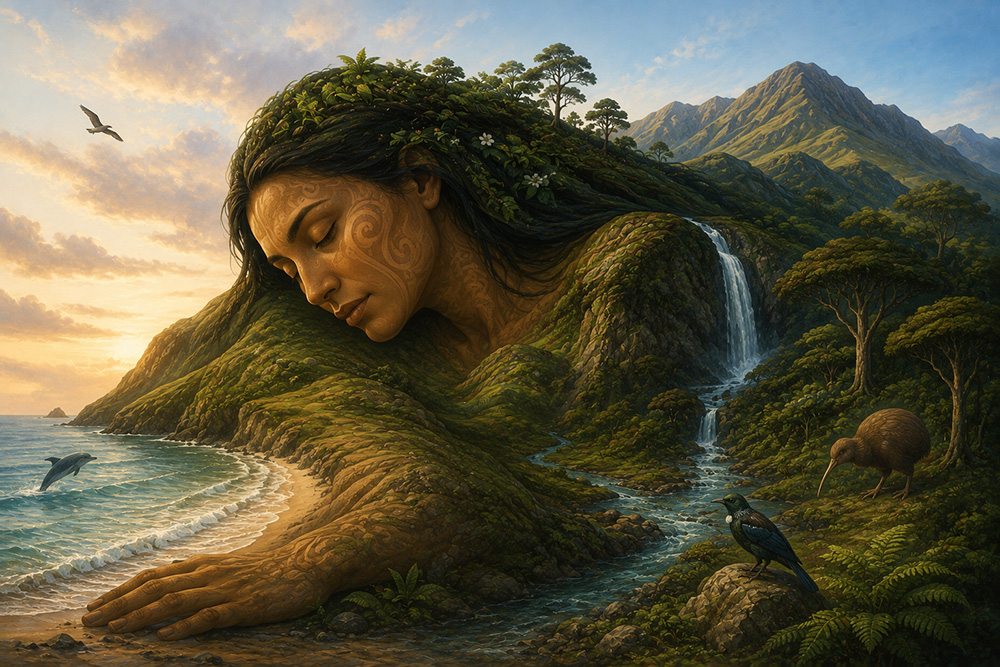
The primordial separation was not a rupture, but the creation of a space for relationship, where Rangi's lament still falls as the morning dew and Papa's warmth still emanates from the thermal springs of Aotearoa.
Well, each cosmogony is a universe unto itself, a complete system of meaning that guides, comforts, and challenges its peoples. Together, they form an intangible heritage of humanity, a diverse and profound testament to our wonder before the mystery of origin.
It is also worth exploring other Cosmogonies, such as Celtic, Egyptian, Coptic, and Australian Aboriginal.
The question remains the same: “Where did we come from?”
But the answers continue to evolve, whether at the altar, in the laboratory, or in the human heart that, filled with wonder, continues to gaze upon the starry sky.
May the Light of Love be the guide of all paths, at all times, in all circumstances, with all the people. And may Love foster Peace!
Bibliographical references
1. BEST, Elsdon. Maori Religion and Mythology. Museum of New Zealand Te Papa Tongarewa, 1924.
An encyclopedic and fundamental work, based on extensive research with Maori experts (tohunga) in the late 19th and early 20th centuries.
2. HENARE, Manuka. “Tapu, Mana, Mauri, Hau, Wairua: A Maori Philosophy of Vitalism and Cosmos.” In Indigenous Traditions and Ecology (ed. Grim), 2001.
An academic article that deeply explores the central philosophical concepts of the Maori worldview and their relationship to creation.
3. ROYAL, Te Ahukaramū Charles. “Whakapapa: A Maori Way of Knowing and Being.” Te Kaharoa, 2012.
Written by a renowned Maori scholar, this work explains the concept of Whakapapa as the foundation of all knowledge, identity, and cosmology.
4. REED, A. W. Treasury of Maori Folklore. A.H. & A.W. Reed, 1963.
An accessible and popular collection of Maori myths and legends, including several versions of the creation narratives, very useful as an introduction to these stories.